



Decorative Modern Islamic Wall Art
Modern Islamic wall art: how contemporary pieces reinterpret classical calligraphy, and how to place them in a minimalist interior.

On this page
"Modern" is doing a lot of work in the phrase modern Islamic wall art, and it usually means one of three different things. Knowing which one a piece belongs to is the difference between something that settles into your room and something that fights it.

Three things "modern" can mean
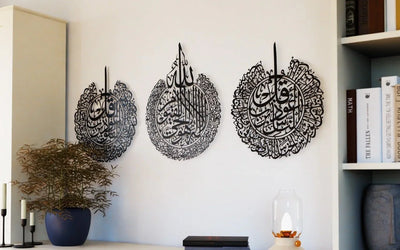
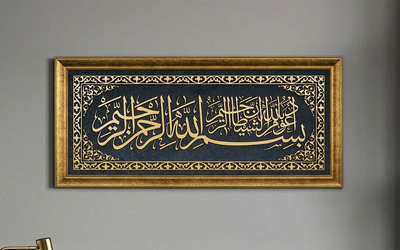
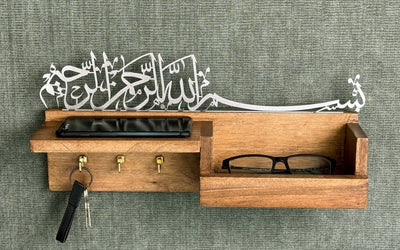
- Modern manufacture, classical design. A traditional Thuluth or Kufic composition, laser-cut from steel or acrylic instead of carved or written. The design is centuries old; only the process is new. Most calligraphic wall art falls here.
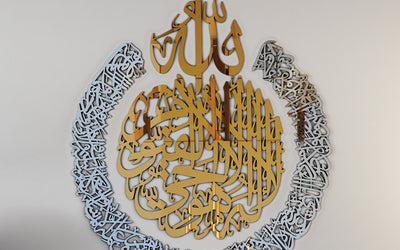
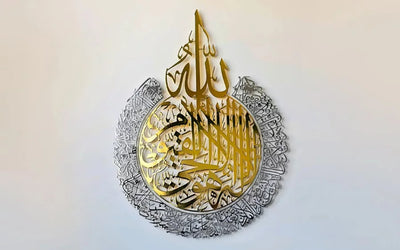
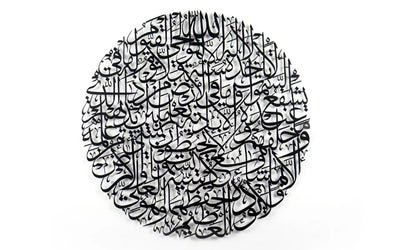
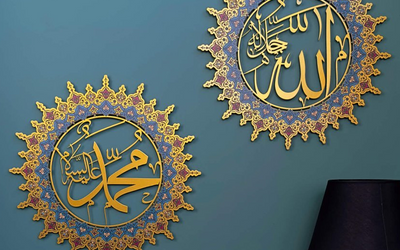
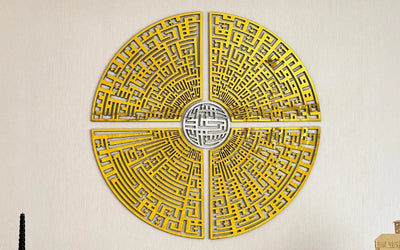
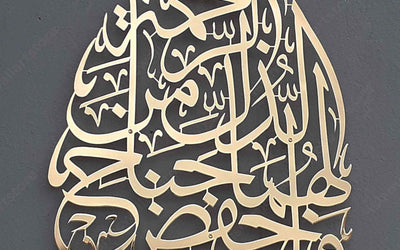
- Modern composition. The letterforms are classical but the arrangement is not — text set into a circle, a square grid, a split panel, a shape that no manuscript page would have used. The circular Ayatul Kursi is this category: the script is traditional, the format is a designer's decision.
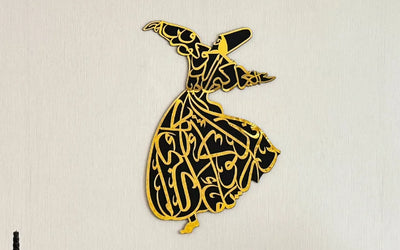
- Modern lettering. The letterforms themselves are new — drawn to a contemporary type designer's logic rather than to any historical canon. These read as graphic design that happens to be in Arabic. There is nothing wrong with them, but they are not classical scripts, and a seller who labels one "Thuluth" is guessing.
The reason this matters practically: category one and two age well, because they are anchored to something older than the current decade. Category three ages the way graphic design ages.
A note on the word "Khatt"
You will often read that Islamic calligraphy divides into "Kufic and Khatt", with Khatt described as the rounded, Ottoman form. That is a misunderstanding that has been copied across a great many websites.
Khatt (خط) is simply the Arabic word for line, script or handwriting. It is the general term for calligraphy itself, not a style within it — khatt kufi means "Kufic script", khatt thuluth means "Thuluth script". Kufic is not the opposite of Khatt; Kufic is a khatt.
The real division is between the angular family (Kufic and its descendants) and the cursive family codified in the tenth century as the six pens — Thuluth, Naskh, Muhaqqaq, Rayhani, Tawqi' and Riqa'. Our guide to the scripts sets out how to tell them apart.
What makes a piece work in a contemporary interior
Contemporary rooms are less forgiving than traditional ones, because there is less going on to absorb a mistake. Four things decide it:
| Factor | What to aim for |
|---|---|
| Negative space | A minimalist room needs the piece to have air inside it. Dense, edge-to-edge compositions read as heavy against plain plaster; open ones read as drawing. |
| Palette discipline | One metal per wall. Gold and silver in the same composition works when the design intends it; gold art next to silver fittings usually does not. |
| Edge quality | In a plain room the cut edge is visible from across the space. This is where cheap laser work shows — look for clean inner curves, not just a clean outline. |
| Scale honesty | Modern interiors have larger uninterrupted wall planes. A piece sized for a traditional room looks lost on one. Measure the wall, not the memory of another room. |
Formats that suit a minimalist wall
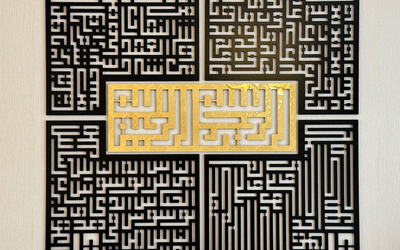
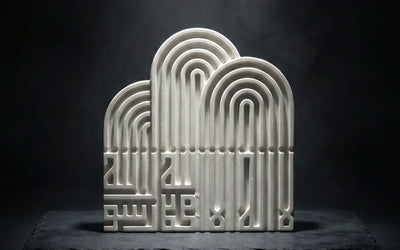
- Geometric Kufic squares. Built to a grid in the first place, so they hold their proportions at any size and sit naturally against straight architecture. See the Kufic collection.
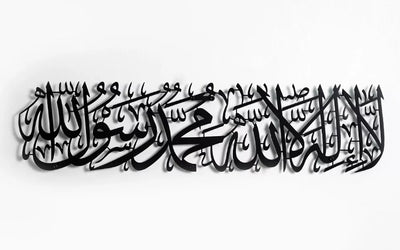
- Long horizontal panels. The single easiest piece to place above a sofa or a low sideboard — one line, one fixing height.
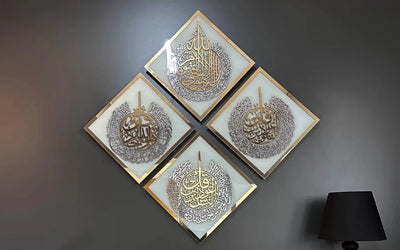
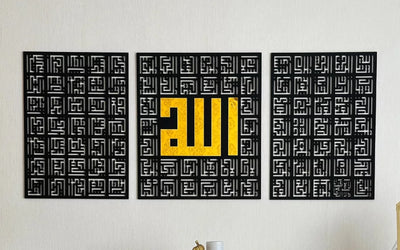
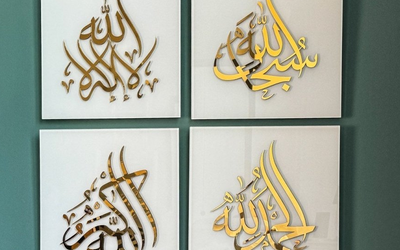
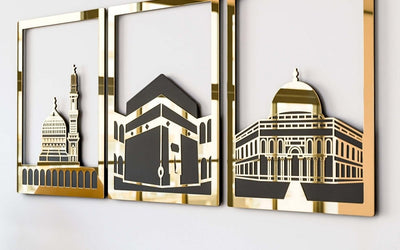
- Multi-piece sets. Repetition is a modern device. Three or four identical-format panels in a row read as deliberate in a way one large piece cannot.
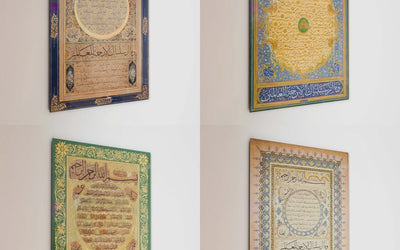
- Tempered glass. The only material here that brings colour as well as form. Glass pieces come on black mirror, solid white and painted grounds.
Where to start
- Bismillah and the four Qul surahs in Kufic — a square from 70×70 up to 150×150 cm, the clearest example of grid-built calligraphy.
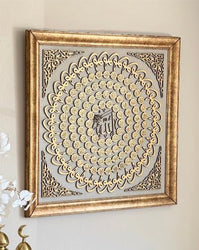
- 99 Names of Allah in metal — 47, 60 or 90 cm square, in gold, silver or black.
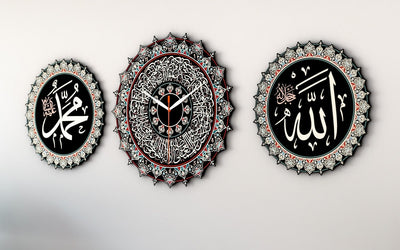
- Allah and Muhammad in a drop design — a paired piece, 20×30 to 50×75 cm, where the shape is the modern element.
The full Islamic wall art collection covers metal, wood and acrylic, tempered glass and canvas, with dimensions on every product page.


Leave a comment