














Islamic Wall Art Size Guide: Which Size Fits Which Wall
Measure the wall, not the art: target 60–75% of the width of the furniture below it. A size chart by wall type, plus what a year of our orders shows.


On this page
Measure the wall, not the piece. For art hung above furniture, aim for a width of 60–75% of the furniture below it; on an empty wall, about two-thirds of the usable wall width. In practice that puts most living-room pieces between 90 and 130 cm across. Our own order data points the same way, from a different direction.
Size is the hardest thing to judge from a product photograph: a piece shot alone on a white background gives no reference for scale, so the instinct is to picture it smaller than it is and order accordingly. Below are a chart to measure against and the order figures behind it.
Start with the wall, not the art
The useful number is not the size of your room. It is the width of the thing the art will sit above, or the width of clear wall if there is nothing beneath it.
- Art above furniture — a sofa, a bed, a sideboard, a console. Take the furniture width and multiply by 0.6 to 0.75. A 220 cm sofa wants something 130–165 cm across, whether that is one piece or a group.
- Art on open wall — take the wall width between whatever bounds it (a door frame, a corner, the edge of a window) and use about two-thirds.
- Leave the gap. Between the top of the furniture and the bottom of the art, 15–25 cm reads as deliberate. More than about 30 cm and the two stop looking related.
Hanging height is a separate question from size, and simpler: the center of the piece at roughly 145–155 cm from the floor, which is standing eye level for most people. Over a sofa, the gap rule wins — measure up from the back of the sofa rather than down from the ceiling.
See what a year of orders says about size
We looked at every order in the twelve months to September 2026 where the item carries a centimeter measurement — 7,516 orders across the wall art catalog — and sorted them by the longest side of the piece.
| Longest side | Share of orders |
|---|---|
| Under 50 cm · under 20″ | 15% |
| 50–69 cm · 20–27″ | 30% |
| 70–99 cm · 28–39″ | 38% — the busiest band |
| 100 cm and over · 39″+ | 18% |
85% of what we ship measures 50 cm or more on its longest side. That figure on its own could just reflect what we happen to stock, so we narrowed it to the 43 products that offer three or more sizes — the cases where the customer makes a genuine choice between a small, a medium and a large of the same design:
- Smallest option: 23% of orders
- Middle options: 39%
- Largest option: 38%
In 39 of those 43 products, the most-ordered size is 50 cm or more on its longest side. Given a free choice, buyers take the small one less than a quarter of the time.
The lesson is not “buy the biggest”
This is where the data gets more interesting than the usual advice. In several products the top seller sits one step below the largest available size:
| Piece | Orders by size, longest side |
|---|---|
| Horizontal Basmala, metal | 69 cm → 111 · 130 cm → 123 · 179 cm → 86 |
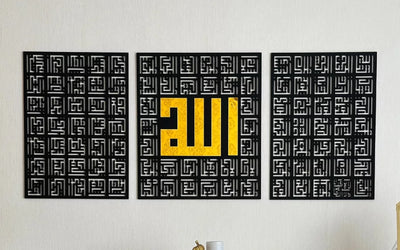
| Four-surah Kufic set, square | 70 cm → 24 · 90 cm → 55 · 120 cm → 66 · 150 cm → 18 |
| 99 Names, square metal | 47 cm → 53 · 60 cm → 118 · 90 cm → 94 |

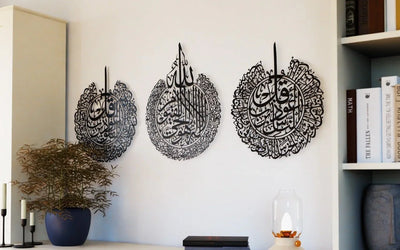
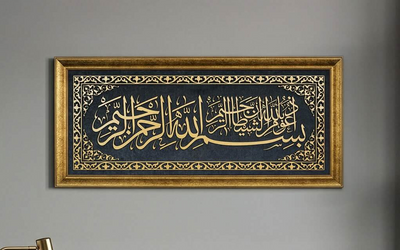
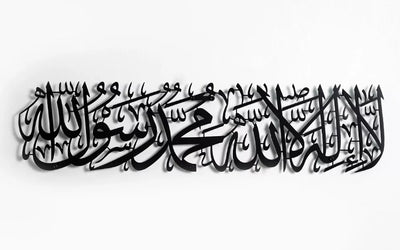
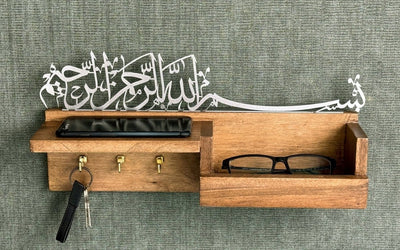
Shown: the horizontal Basmala band, in matte black.
Read together with the first table, the pattern is consistent: the smallest option is almost always the wrong one, and the very largest is a specialist choice for a wall that can genuinely carry it. The reliable answer sits in the upper middle of whatever ladder you are looking at. If you are choosing between three sizes and have no strong reason either way, the second-largest is the safest bet.
One caveat: these are order counts, not satisfaction scores. They show what people chose, not what they later wished they had chosen, and they show that the crowd is not buying small.
Use the size chart to match a wall to a size
Measure the item in the middle column, apply the 60–75% rule, and check the result against what is actually stocked. Sizes in the last column are real options from our catalog, not rounded targets.
| Where it goes | Measure | Target width | Sizes that land there |
|---|---|---|---|
| Above a three-seat sofa | Sofa width, 200–220 cm | 120–165 cm | 130×30 · 140×55 · 120×120 |
| Above a two-seat sofa | Sofa width, 140–160 cm | 85–120 cm | 90×90 · 102×86 · 99×24 |
| Above a king bed | Bed width, 160–180 cm | 100–135 cm | 130×30 · 102×86 · 120×120 |
| Above a double bed | Bed width, 135–140 cm | 80–105 cm | 90×90 · 90×115 · 99×29 |
| Above a console or sideboard | Furniture width, 100–120 cm | 60–90 cm | 67×87 · 69×15 · 60×60 |
| Empty feature wall | Usable wall width, 250 cm+ | 150 cm+, or a set | 179×40 · 140×55 four-piece · 150×150 |
| Entryway, above a shoe cabinet | Cabinet width, 80–100 cm | 50–75 cm | 69×15 · 60×60 · 50×65 |
| Narrow hallway, between doors | Clear gap, 60–90 cm | 40–65 cm | 47×47 · 49×63 · 37×47.5 |
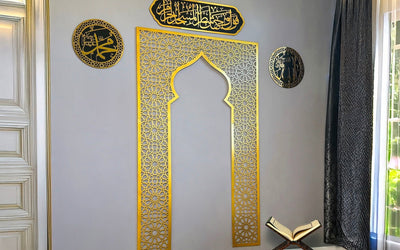
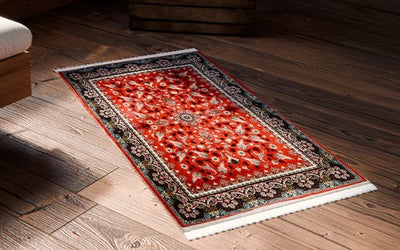
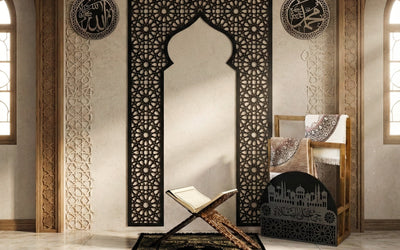
| Prayer corner, above the rug | Wall above a 70–80 cm rug | Height matters more than width | 68×90 · 70×90 · full-height panel |
Two rows deserve a note. A narrow hallway is the one place where small is correct; it is the exception the order data hides, because hallway pieces are a small share of what we sell. The prayer corner row breaks the width rule: the piece is seen from standing, bowing and kneeling, so its height does the work. See our guide to setting up a prayer corner at home.
Let the shape change the answer
Two pieces with the same longest side can behave completely differently on a wall. The proportion decides which rule applies.
Long and low
A horizontal calligraphy band is measured against width alone, and it is the most forgiving shape above a sofa because its height barely competes with anything. This is the shape where our data showed the middle size winning: the long horizontal band that comes in three lengths sells best at 130 cm, not at its full 179 cm. Above a standard three-seat sofa, 179 cm overruns the furniture; above a 240 cm sectional, it is the only one that works.
Upright
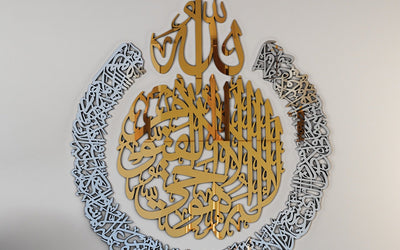
A vertical piece is judged on height rather than width, and it is the right answer in narrow spaces — between two doors, beside a window, in the strip of wall a hallway leaves you. An upright panel offered in three heights climbs steadily with size in our figures: 47 cm took 25 orders, 65 cm took 32, and 87 cm took 62. Height carries an upright piece in a way width does not.

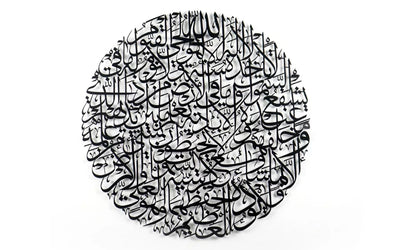
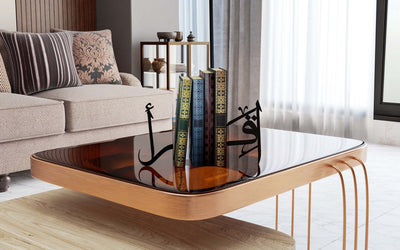
Shown: this upright Ayatul Kursi panel, in shiny gold.
Square and circular
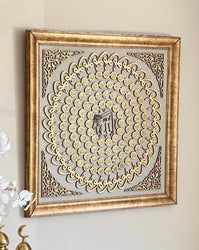
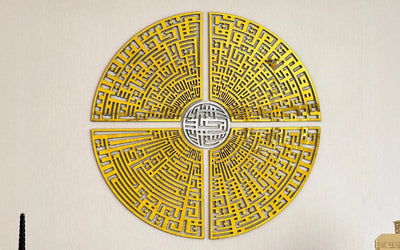
Square and round pieces read larger than their measurement suggests, because the eye registers area rather than the longest edge. A 60 cm square covers 3,600 cm² of wall; a 90 cm band 25 cm tall covers 2,250 cm². The square is the bigger object despite the smaller headline number, which is why square sizes need stepping down rather than up. On our 99 Names square, the 60 cm outsold the 90 cm by 118 orders to 94 — at 90 cm a square stops being a picture and becomes an architectural feature, and most walls are not asking for one.

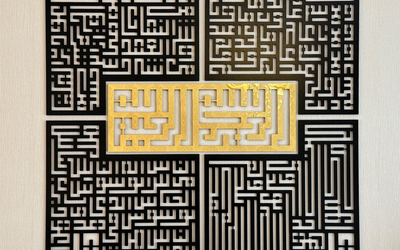
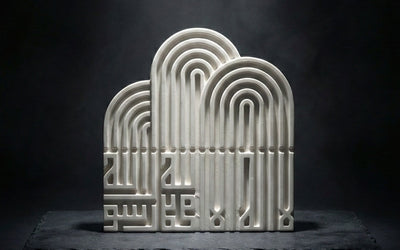
Shown: the 99 Names square in metal, in gold.
Sets: measure the group, not the piece
Multi-piece arrangements are where size guides usually fall over, because the individual measurement stops being the useful number.
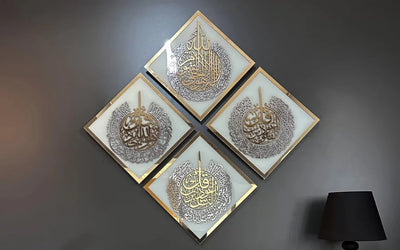
For a set, calculate the total span: the width of all pieces, plus the gaps between them. Gaps of 5–10 cm for small pieces and 10–15 cm for larger ones keep a group reading as one object rather than several. A three-piece set of 40 cm panels with 10 cm gaps spans 140 cm, not 40 — and it is the 140 that has to satisfy the 60–75% rule.
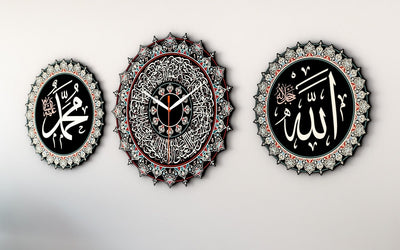
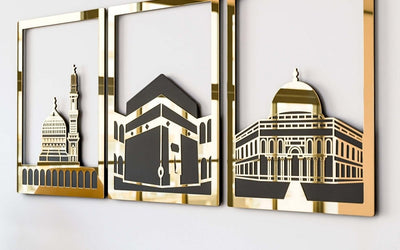
The practical consequence: a set almost always needs more wall than people expect and is the arrangement most likely to be under-ordered. A two-piece arrangement like this one is sold by the dimensions of the assembled composition rather than of either piece, so check which convention a listing uses before you order.
If you are building a gallery wall from separate pieces, the same arithmetic applies. Also keep the outer edges of the group aligned to an invisible rectangle: a group that wanders vertically looks like an accident rather than an arrangement.
Run the tape test and check two numbers before you order
Ninety seconds of masking tape settles more size arguments than any chart. Mark the outline of the piece on the wall at the height you intend to hang it, leave it there for a day, and look at it from where you normally sit. Scale reads completely differently from two meters away than it does on a screen held at arm's length.

Then check two numbers on the product page before you commit:
- Which dimension is quoted. On a multi-piece set, confirm whether the measurement is the whole composition or one piece. This is the single most common source of a size surprise.
- The weight. Size and fixing requirements travel together. A metal piece at 67×87 cm and above generally needs a proper wall fixing rather than adhesive, and the right fixing depends on whether you are going into drywall, brick or plaster. Check the listed weight before assuming the hanging method.
Frequently asked questions
How wide should art be above a sofa?
60–75% of the furniture's width: a 220 cm sofa wants something 130–165 cm across, with 15–25 cm between the sofa and the art.
What size sells best?
The 70–99 cm band is the busiest, with 38% of 7,516 orders in the twelve months to September 2026, and 85% of what we ship measures 50 cm or more on its longest side.
How do I size a multi-piece set?
Calculate the total span: the width of all pieces plus the gaps (5–10 cm for small pieces, 10–15 cm for larger ones). A three-piece set of 40 cm panels with 10 cm gaps spans 140 cm.
Every dimension quoted in this guide is listed on the product pages. Browse our metal Islamic wall art, with sizes on every listing, and compare the options against the chart above.
A note on scope: this guide covers measurement, proportion and installation only. Questions of religious practice, including where and how Qur'anic text should be displayed in the home, are matters on which scholars differ, and we would encourage you to consult your own local scholar rather than take guidance from a retailer. Order figures are from our own store data for the twelve months to September 2026, covering 7,516 orders where the item carries a centimeter measurement. Room scenes were generated with AI image tools; the artwork in each is a photograph of the actual product, scaled to its listed dimensions. This article was prepared with AI assistance. Updated November 2026: added a FAQ and action headings, and removed an unsupported review claim.
Find the piece for your wall
Browse the collection behind this guide. You have 30 days after receiving your order to request a return.


Leave a comment