




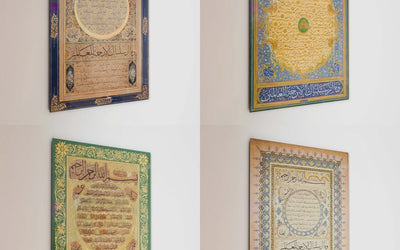

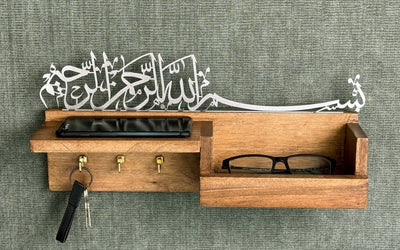

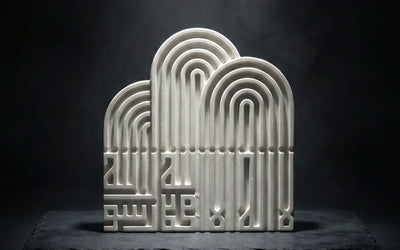
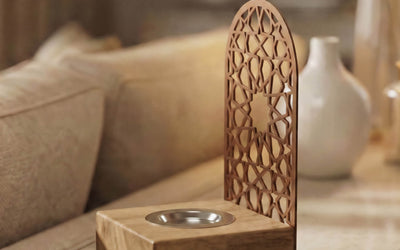




Decorative Wooden Islamic Wall Art
Wooden Islamic wall art: grain, finish and weight, how wood differs from metal in a room, and where it hangs best.

Sur cette page
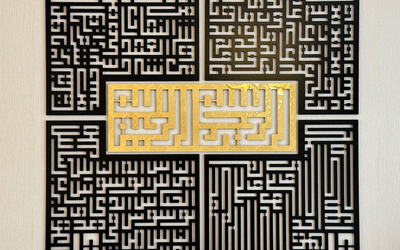
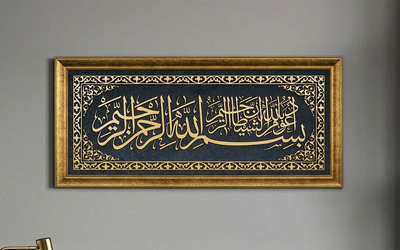
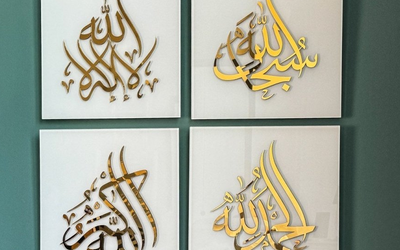
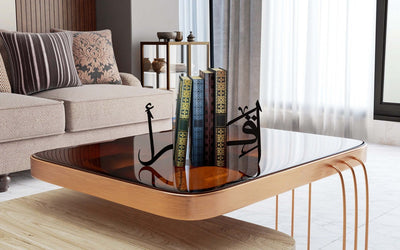
Most of what is sold as "wooden Islamic wall art" is not a single material. It is laser-cut acrylic calligraphy mounted on a painted wood or MDF back panel — and that back panel, more than the wood itself, is what decides where the piece will work.

The back panel is the whole difference
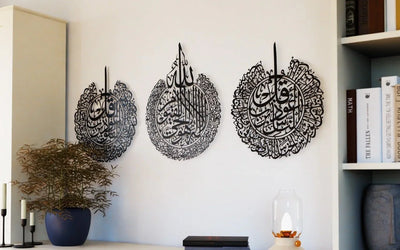
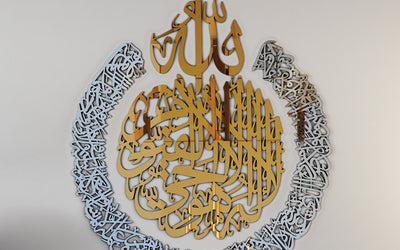
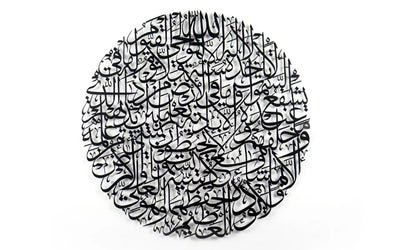
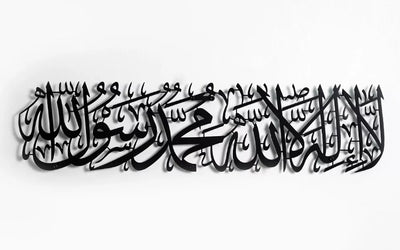
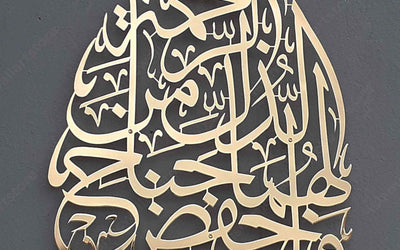
Cut metal has no background. Whatever colour your wall is becomes the background of the artwork, and the piece is read as a silhouette. That is why metal looks so good on a plain pale wall and so poor on a busy one.
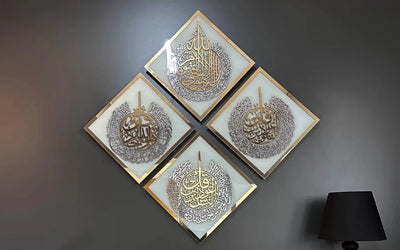
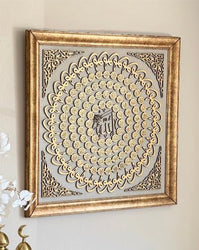
Wood-and-acrylic pieces carry their own background. The calligraphy sits on a white or black board, framed by its own edge. The practical consequences:
- They work on walls where metal fails. Wallpaper, exposed brick, dark paint, a textured render — anywhere a cut-out silhouette would be lost, a panel piece still reads.
- They are more forgiving of lighting. There is no gap for a shadow to fall through, so the piece looks the same at noon and at night.
- They are heavier. Same dimensions, more mass. Check the fixing before assuming a hook that held a metal panel will hold this.
- They set the colour scheme rather than borrowing it. A black board is a strong graphic object in a pale room. A white board disappears into a white wall and leaves only the calligraphy visible — effectively the metal look, but with a crisper edge.
That last point is the choice most people find hardest, so it is worth being blunt about it: white panel if you want the words to float, black panel if you want the piece to be an object.
What the order data says
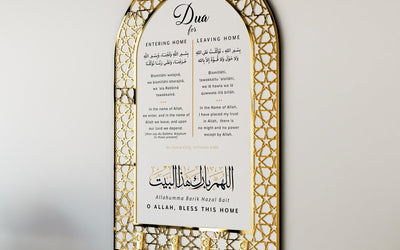
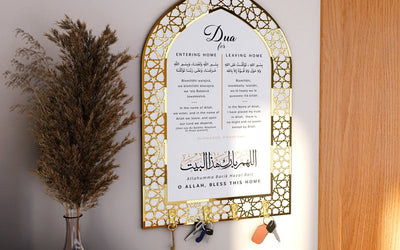
Over the past twelve months, the single best-selling item in our entire catalogue is not a wall panel at all — it is a wood-and-acrylic piece for the hallway: the Dua for Entering and Leaving Home key holder. Two patterns inside it hold across nearly every wood piece we make:
- 30×45 cm is the size people buy. It outsells the 20×30 cm by roughly two to one and the 40×60 cm by more than three to one. For a panel that hangs beside a door rather than over furniture, that is about right — big enough to read, small enough not to crowd the entry.
- Gold acrylic on a white panel is the leading combination, with gold on black second. Silver acrylic sells, but at roughly a third of gold's volume.
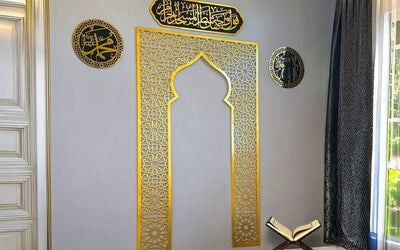
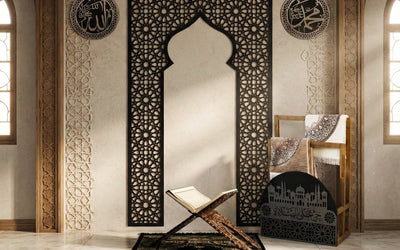
On larger wall pieces the size logic reverses. The wooden Kalima Tawheed mihrab panel sells overwhelmingly at 68×90 cm in gold on black, and the 99 Names wooden-acrylic pieces sell best at the largest 75 cm height, usually in threes. Where the piece is the focal point of a wall, buyers go up; where it is a functional object beside a door, they stay in the middle.
Formats worth knowing
| Format | Typical size | Suits |
|---|---|---|
| Single panel | 30×45 to 90×120 cm | One clear wall — above a console, beside a door, over a bed |
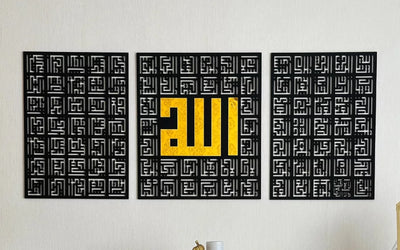
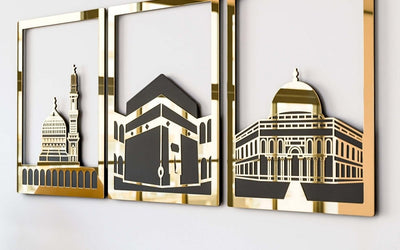
| Three-panel set | 30×40 to 50×66 cm each | A wide wall where one large piece would overwhelm |
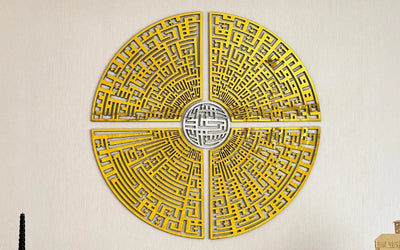
| Square or circular | 70×70 to 150×150 cm | Stairwells, double-height walls, a wall with no furniture beneath |
| Shelf and mantel pieces | 30×11 to 60×21 cm | Leaning rather than hanging — no drilling required |
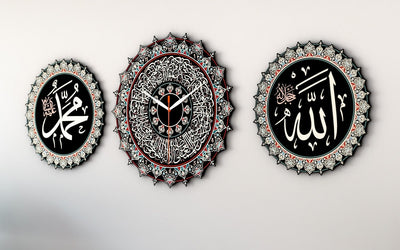
The three-panel Ayatul Kursi set is the most common way to fill a wide wall; shelf pieces are the option for rented homes where drilling is not allowed.
Living with wood
Wood moves with humidity and acrylic scratches. Neither is a problem in a normal room, but two placements cause almost all the complaints we see:
- Directly above a radiator. The rising dry heat is concentrated and cyclical; over a couple of winters it can open a joint or lift a veneer. Move the piece to the side, or up.
- Bathrooms and unventilated kitchens. Sustained humidity swells MDF at the cut edges. Glass or metal is the right material for those rooms.
For cleaning, a dry or barely damp microfibre cloth is enough. Solvent cleaners and alcohol wipes will haze acrylic permanently, and a dusty cloth is what puts the fine scratches into a gold acrylic face.
Wood, metal or glass
If you are still deciding between materials rather than pieces:
- Wood and acrylic — busy or dark walls, warmer rooms, pieces that should read as objects. Browse the wood and acrylic collection.
- Metal — plain pale walls, large spans, the crispest silhouettes. See the metal collection.
- Tempered glass — humid rooms, and colour that metal and wood cannot produce. See the glass collection.


Laissez un commentaire