


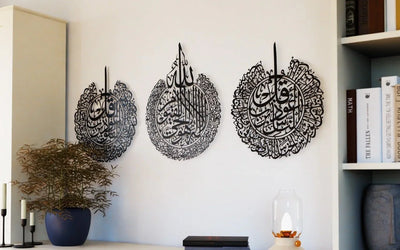
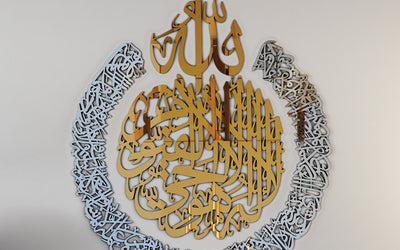
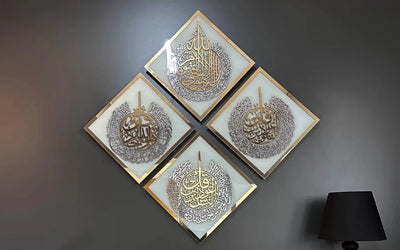
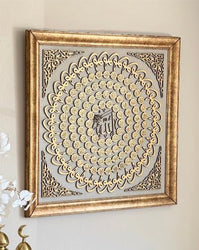
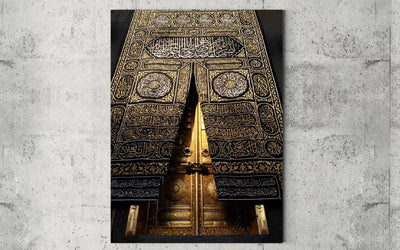
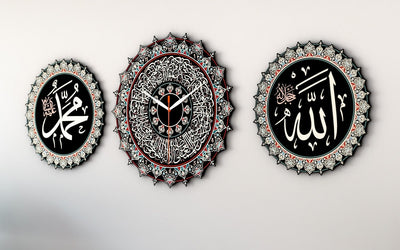
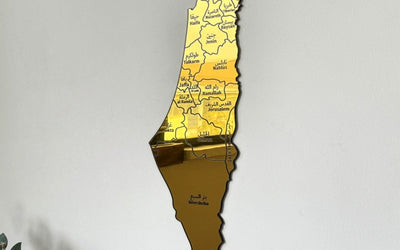
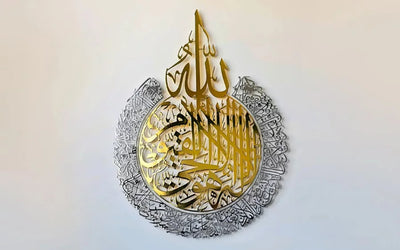
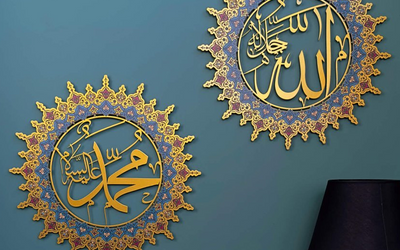
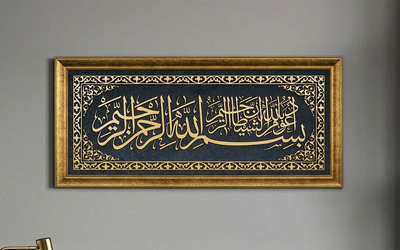
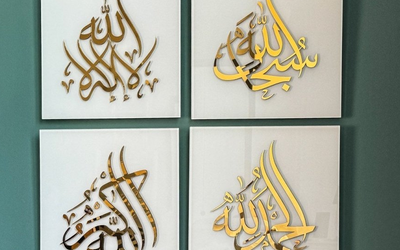
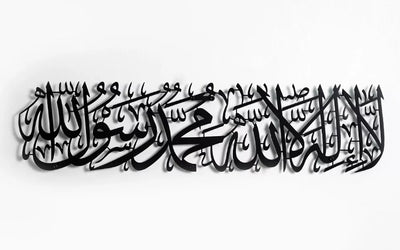
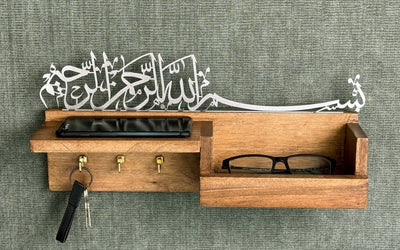

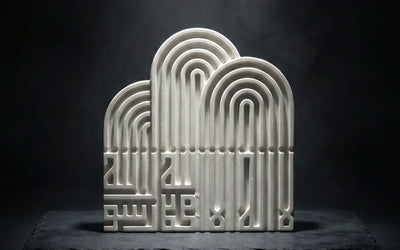
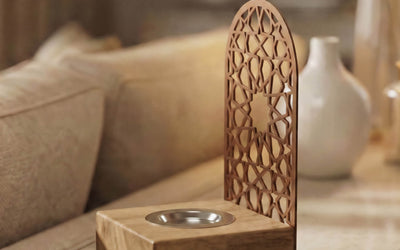
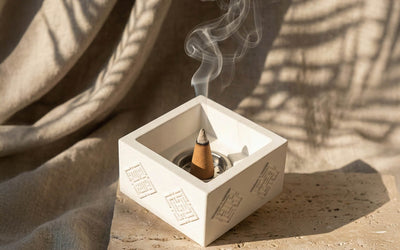
Modern Islamic Metal art for Wall of Every Muslim Home
Modern Islamic metal wall art: how laser-cut panels are made, the finishes available, and what changes at different sizes.

On this page
Laser-cut metal is now the default material for Islamic wall art, and almost nothing written about it explains how to tell a good piece from a poor one. The difference is visible from two metres away once you know what to look at — and most of it comes down to a single technical constraint that calligraphy in cut metal cannot escape.

The bridge problem
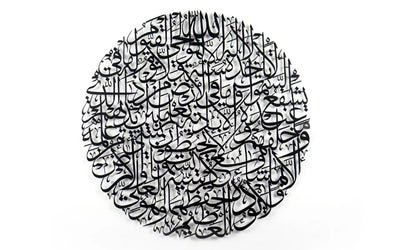
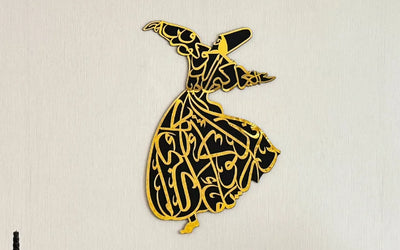
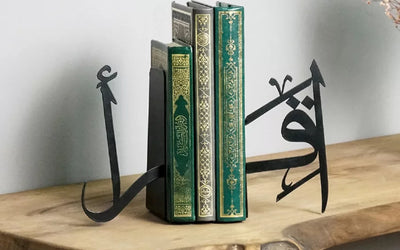
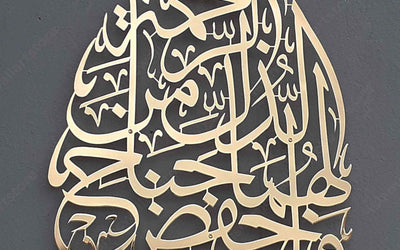
Cut a shape out of a sheet of steel and anything fully enclosed inside it falls out. In Arabic calligraphy that is a constant issue: the counter inside a ha, the loop of a waw, the eye of a mim — every one of them is an island that has to be held in place by a physical connection to the rest of the design.
Those connections are called bridges, and how a design handles them is the clearest quality signal in the whole category:
- Good design hides the bridge in the letter's own logic. The connection follows a stroke the eye already expects, or lands where two letters would naturally touch. You do not notice it until you look for it.
- Poor design adds a straight tab. A little bar crossing a curve at ninety degrees, put there by the software rather than the calligrapher. Once you have seen one you will see them everywhere.
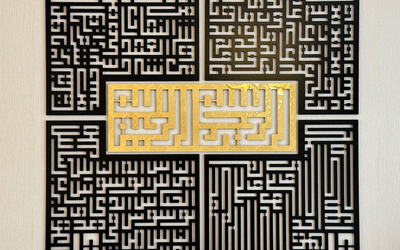
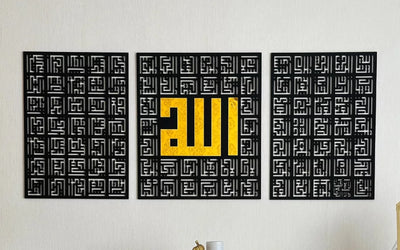
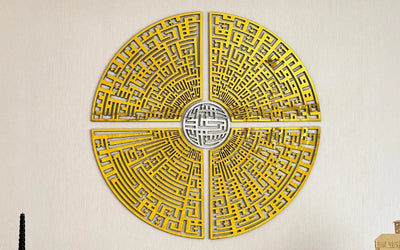
This is why traditional scripts do not all cut equally well. Kufic, built on a grid of straight lines with few enclosed counters, needs almost no bridging — which is why Kufic designs survive cutting and scaling better than any other script. Thuluth, with its deep bowls and enclosed forms, is much harder, and a well-executed cut Thuluth panel is genuinely more work than it looks.
Four other things to look at
| What | What good looks like |
|---|---|
| Inner curves | The outline of a piece is easy to cut cleanly. Tight inner curves are not. Look at the smallest enclosed shape in the design — if it is crisp, the rest will be. |
| Flatness at size | Thin sheet at large spans can ripple, a defect known as oil-canning. It shows as a wave in reflections across a polished surface. Larger pieces need either thicker stock or a frame behind them. |
| Finish consistency | Polished metal shows every variation. Look along the surface at a shallow angle, not straight at it. |
| Fixing points | Keyhole slots let you level a piece after it is on the wall. A single central hook does not. On multi-piece sets this is the difference between an hour and ten minutes. |
Why metal for large pieces
The practical case for metal over wood or glass at scale is weight per square metre. A cut metal panel is mostly air — the letterforms are all that remains of the sheet — so a piece a metre and a half wide can still hang on ordinary plasterboard anchors. A wood-and-acrylic panel of the same dimensions carries a full back board and weighs several times more; tempered glass more again, and it cannot be made in shapes that are not rectangles.
That is why the largest pieces in almost every catalogue are metal, and why long horizontal panels — up to 179 cm on the Thuluth Bismillah — exist as a format at all.
The trade-off nobody mentions
Cut metal has no background. Your wall shows through the letterforms and becomes part of the artwork, which is exactly why it looks so good on plain plaster and disappointing on wallpaper, exposed brick or a dark textured wall. If your wall is busy, the material to choose is wood and acrylic, which brings its own back panel.
The same property is why shadow matters. A cut panel standing a few millimetres off the wall casts a second, softer version of itself. On a wall lit from the side that doubles the visual weight of the piece; on a flatly lit wall it does nothing at all.
Care
- Dust with a dry microfibre cloth, following the direction of the strokes. Dust sits in the inner corners of cut letterforms and a dry cloth reaches them; a damp one just moves it around.
- No abrasives, no solvent cleaners, no glass spray on coated or plated finishes. Polished finishes will show fingerprints — that is the price of the finish, not a fault.
- Indoor only, unless a piece is specifically described as suitable for outdoors. Coated steel intended for interiors will eventually corrode at the cut edges outside.
- Not directly above a hob or in a shower room. Cooking grease films onto a cut surface and is very hard to remove from inner corners.
Where to look
- Ayatul Kursi in four pieces — 94×38 or 140×55 cm, seven finishes. A good example of splitting a long text so no single panel needs to be enormous.
- First Kalimah in shiny metal — 65×16 or 99×24 cm, in gold, silver or copper.
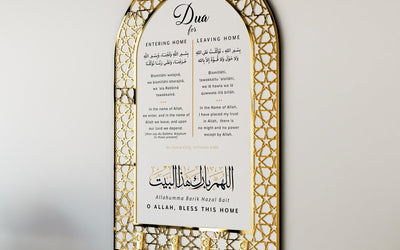
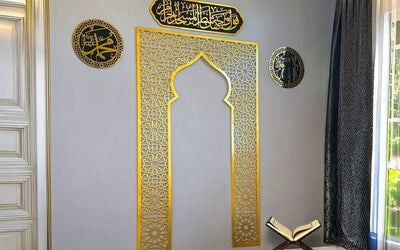
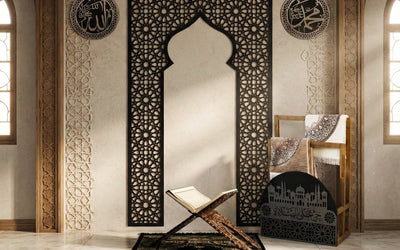
- Metal mihrab set — an arched panel for a prayer wall, in medium or large.
The full metal Islamic wall art collection lists dimensions and finish on every product page. For sizing a piece against furniture, see our guide to metal wall decor for the living room.


Leave a comment