












How to Hang Metal Wall Art on Drywall: Weight and Hardware
Pick hardware rated for twice the piece's weight. Our best-selling metal pieces weigh 0.8–6.5 kg; here's how to find studs, choose anchors and hang level.

On this page
Look up the weight first, then choose the hardware. Our best-selling metal wall pieces weigh between 0.8 and 6.5 kg (1.8–14.3 lb), and drywall on its own holds very little. Anything over about 2 kg (4.4 lb) belongs on a stud or a proper drywall anchor, and a sensible margin is hardware rated for at least twice the weight of the piece.
The size of a piece tells you surprisingly little about how to hang it. A long, thin calligraphy band can weigh less than a compact square, because cut metal is mostly air and a printed or solid panel is not. So the useful number is the weight of the exact size you ordered, and that is where this guide starts.
Look up the weight of your size, not the design
Every size of every design has its own weight. Here are the catalog weights for our best-selling metal pieces, with the hanging arrangement each listing describes:
| Piece | Size | Weight | How it hangs (per listing) |
|---|---|---|---|
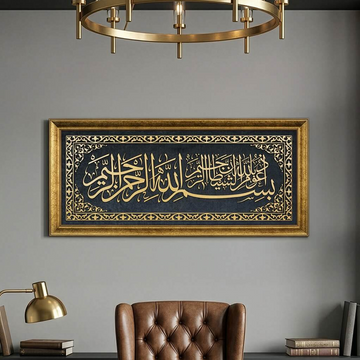
| Horizontal Bismillah band | 69 × 15 cm · 27.2 × 5.9″ 130 × 30 cm · 51.2 × 11.8″ 179 × 40 cm · 70.5 × 15.7″ |
0.8 kg (1.8 lb) 1.4 kg (3.1 lb) 2.4 kg (5.3 lb) |
Hanging hardware included. The 69 cm size is one piece; the 130 and 179 cm sizes come in two pieces. |
| Upright Ayatul Kursi panel, shiny or matte | 37 × 47.5 cm · 14.6 × 18.7″ 50 × 65 cm · 19.7 × 25.6″ 67 × 87 cm · 26.4 × 34.3″ |
1.3 kg (2.9 lb) 2.0 kg (4.4 lb) 3.5 kg (7.7 lb) |
One bracket on the back, hung on a single nail. |
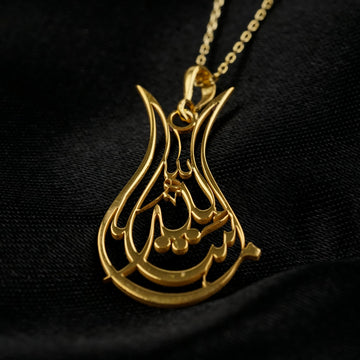
| Tulip-shaped Ayatul Kursi | 43 × 67 cm · 16.9 × 26.4″ 57 × 90 cm · 22.4 × 35.4″ |
2.0 kg (4.4 lb) 3.2 kg (7.1 lb) |
Inner and outer parts mounted one at a time; three hanging points. Four screws and four wall anchors included. |
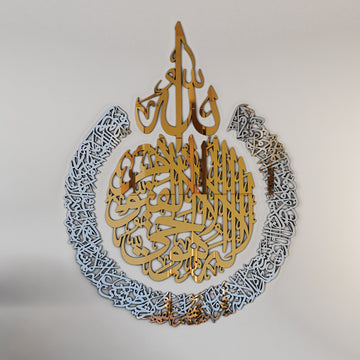
| Ringed Ayatul Kursi | 49 × 63 cm · 19.3 × 24.8″ 70 × 90 cm · 27.6 × 35.4″ 90 × 115 cm · 35.4 × 45.3″ |
2.1 kg (4.6 lb) 3.8 kg (8.4 lb) 5.7 kg (12.6 lb) |
Three nails: two at the upper tips of the outer ring, one at the top center of the inner part. |
| 99 Names square | 47 × 47 cm · 18.5 × 18.5″ 60 × 60 cm · 23.6 × 23.6″ 90 × 90 cm · 35.4 × 35.4″ |
2.1 kg (4.6 lb) 3.3 kg (7.3 lb) 6.5 kg (14.3 lb) |
Hanging hardware included. |
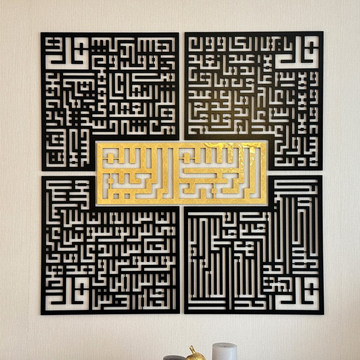
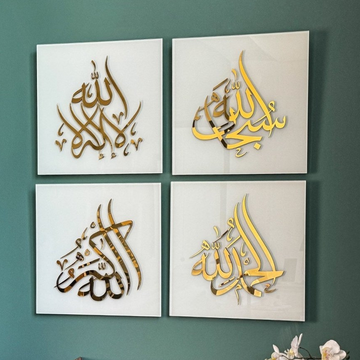
| Four-piece Ayatul Kursi | 94 × 38 cm · 37 × 15″ overall 140 × 55 cm · 55.1 × 21.7″ overall |
2.7 kg (6.0 lb) in total 4.9 kg (10.8 lb) in total |
Four separate pieces, each hung on its own. |
| Full-height mihrab, mihrab only | 90 × 150 cm · 35.4 × 59.1″ 115 × 190 cm · 45.3 × 74.8″ |
6.5 kg (14.3 lb) 10.5 kg (23.1 lb) |
Not described on the listing; plan it as a heavy piece (see below). |
Two things stand out. The 179 cm Bismillah band, the longest piece in the table, weighs less than the 60 cm square. And the jump between sizes is not linear: the 90 cm square is nearly twice the weight of the 60 cm one.
Our own orders show why this matters. Across six of these designs (every row except the upright panel), buyers took 1,357 pieces in the twelve months to October 13, 2026, and 742 of them, 55%, weigh 3 kg (6.6 lb) or more, counting a set by its total weight. One in six weighs 5 kg (11 lb) or more. On five of the six designs, the most-bought size is a heavy one:
- On the 99 Names square in metal, the 60 cm size at 3.3 kg sold 116, against 85 at 90 cm and 54 at 47 cm.
- On the tulip-shaped two-part panel, the 3.2 kg size outsold the 2 kg one, 144 to 103.
- On the four-piece Ayatul Kursi set, the 140 cm version at 4.9 kg outsold the 94 cm one, 159 to 41.
- The ringed design sold 98 at 70 × 90 cm (3.8 kg), and the large mihrab outsold the medium, 48 to 31.
- The exception is the horizontal Bismillah band, where even the largest size is only 2.4 kg.
In other words, most people who buy these designs end up hanging more weight than a nail in bare drywall should be trusted with. If you are still deciding on the size itself, our size guide covers how big a piece should be for the wall and the furniture below it.
Check how the back of the piece is built
Before you mark anything on the wall, turn the piece over. Our metal listings describe three different arrangements, and each changes the job:
- One bracket, one nail. The upright Ayatul Kursi panels hang from a single bracket. That is the easiest to level, but one fixing carries the whole weight, so it needs to be the strongest one.
- Several hangers. The ringed design hangs on three nails, two for the outer ring and one for the inner part. The load is shared, but the points have to agree with each other.
- Screws with anchors in the box. The tulip-shaped panel comes with four screws and four wall anchors for its three hanging points.
Measure between the hangers on the actual piece, not from a product photo, and write the distances down. Most of the pieces in the table also stand off the wall, by 1.5 to 2 cm (0.6–0.8″) according to their listings, so the piece casts a shadow and you cannot see the fixing once it is up.

Shown: the horizontal Bismillah band, in matte black.
Find out what is behind the drywall
Drywall is a thin board, usually 12.5 mm (½″) thick, fixed to a frame of vertical studs. A screw into a stud holds far more than any anchor in the board between them, so it is worth finding out where they are.

- Use a stud finder and mark both edges of the stud, then the center. Studs are usually 40 or 60 cm (16 or 24″) apart, center to center, so once you find one you can measure across to the next and confirm it.
- Check for cables and pipes. Many stud finders also detect live wiring. Avoid drilling directly above or below outlets and switches, where cables commonly run.
- Accept that the points rarely line up. A hanging point on a 60 cm square will seldom land exactly on a stud. It is fine to put one point into a stud and another into an anchor, as long as each fixing on its own could carry the whole piece.
Not every wall is drywall. Brick and concrete take a masonry plug and screw, drilled with the hammer setting. Older lath-and-plaster walls crack easily, so drill slowly and aim for the wooden lath or a stud behind it.
Match the hardware to the weight
With the weight and the wall known, the choice is short. Use the weight from the first table:
| Weight of the piece | Into a stud | Into hollow drywall |
|---|---|---|
| Up to 2 kg · 4.4 lb | The nail or screw supplied | A picture hook or a plastic expansion anchor at each point |
| 2–5 kg · 4.4–11 lb | A wood screw at each point | A threaded, self-drilling drywall anchor at each point |
| 5–10 kg · 11–22 lb | Wood screws at two or more points | A toggle bolt, spring or strap type, at each point |
| Over 10 kg · 22 lb | Studs wherever the hanging points allow | Toggle bolts, and two people to lift |
Whatever the type, read the load rating on the packet and pick one rated for at least twice the weight of the piece. Ratings assume the anchor is installed exactly as the packet describes, in sound board. The hardware in our boxes is a good starting point; whether it suits your wall depends on what you found behind the drywall.
Hang it level in six steps
- Confirm the weight of your size from the first table or the product page, and buy hardware rated for twice that.
- Mark the position. Tape the outline of the piece on the wall at the height you want, and look at it from where you usually sit.
- Transfer the hanging points. Use the distances you measured on the back of the piece, measured from the top edge of your tape outline, and check them with a level.
- Check the spot with the stud finder for studs, cables and pipes before drilling.
- Drill and fix each anchor or screw exactly as its packet says; do not skip the pilot hole the packet asks for.
- Hang and check. Lift the piece on, step back, and make sure every spacer touches the wall and the piece does not rock. Adjust before you tidy up.
Line up two-part and multi-piece panels from one mark
Several of the heaviest sellers are not one piece. The 130 and 179 cm Bismillah bands come in two pieces, the tulip and ringed designs have an inner and an outer part, and the four-piece set is exactly that. They go wrong in the same way: each fixing is measured on its own, and the small errors add up into a visible step.
- Draw one level line across the whole width first, then measure every hanging point from that line rather than from the ceiling or the floor, which are rarely level.
- Hang the outer or first part, then check it before marking the next. On the two-part designs, the inner part's position follows from the outer one.
- For the four-piece set, lay the pieces on the floor in their final arrangement, measure the gaps, and copy them to the wall.

Shown: the four-piece Ayatul Kursi set, in black.
Plan a two-person job above 5 kg
Three pieces in the table cross 5 kg: the 90 cm square at 6.5 kg, the largest ringed Ayatul Kursi panel at 5.7 kg, and the full-height metal mihrab at 6.5 or 10.5 kg. At that weight the difficulty is less the anchor than the lift: one person holds the piece flat against the wall while the other guides the hangers onto the fixings.
For the mihrab, find the studs before you choose the exact position, and move the piece sideways a few centimeters if that puts its fixings on solid wood. A mihrab usually anchors a prayer corner, so the floor space in front of it matters as much as the wall; our guide to setting up a prayer corner covers that part.
Every piece in this guide, with its sizes and finishes, is in our metal Islamic wall art collection, with dimensions listed on every product page.
A note on scope: this guide covers weight, hardware and installation only. It is general guidance, not a survey of your wall; if the wall is damaged or unusual, or you are unsure what is behind it, ask a qualified installer. Questions about religious practice, including where and how Qur'anic text should be displayed in the home, are matters on which scholars differ, and we would encourage you to consult your own local scholar rather than take guidance from a retailer.
Weights, sizes and hanging details are taken from our own product listings. Order figures are from our own store data for the twelve months to October 13, 2026. Illustrative images marked as such were generated with AI; product photographs are of our own products. This article was prepared with AI assistance and reviewed by a member of the IWA Concept team before publication.


Leave a comment