



Metal Islamic Wall Decor for the Living Room
Metal Islamic wall decor for the living room: sizing against a sofa wall, finish against your light, and how to hang heavier pieces.

Auf dieser Seite
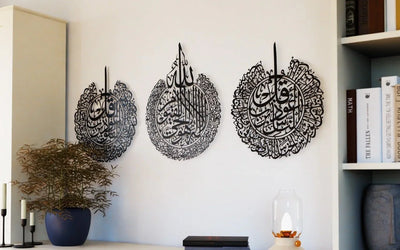
Metal is the most forgiving material for a living room wall: it is light for its size, it holds a hard edge at any scale, and a laser-cut panel casts a shadow line that changes through the day. What decides whether a piece actually works over your sofa is narrower than most guides admit — it comes down to width, finish and fixing.

Start with the sofa, not the wall
The wall is bigger than the piece will ever be, so it is the wrong thing to measure against. Measure the sofa.
The working rule in interior design is that art above a sofa should span roughly two thirds of its width. A three-seater is usually 200–220 cm, which puts the target at about 135–145 cm. A two-seater at 150–170 cm puts it at about 100–115 cm. Anything much narrower reads as an afterthought floating in the middle of the wall; anything wider than the sofa itself makes the seating look undersized.
Two more numbers matter and are easy to get wrong:
- 15–25 cm between the top of the sofa back and the bottom edge of the piece. Closer than that and it looks stuck to the furniture; further and the two stop reading as one group.
- 145–150 cm to the centre of the piece on a wall with no furniture under it — standing eye level. This is the gallery convention and it is the reason a piece hung "in the middle of the wall" so often feels too high.
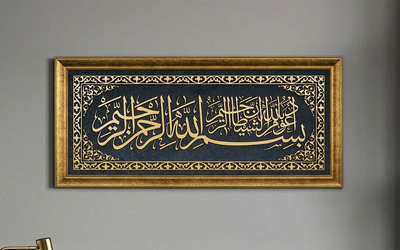
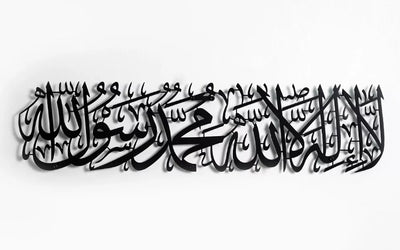
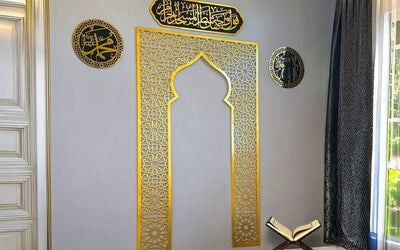
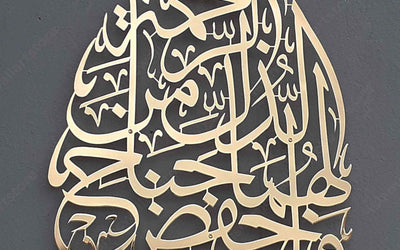
Horizontal calligraphy suits this geometry better than anything else, which is why the format exists. A Thuluth Bismillah panel runs 69×15, 130×30 or 179×40 cm — the middle size sits almost exactly on the two-thirds mark for a two-seater, the largest for a wide three-seater.
Choose the finish against your light, not your taste
Finish is where most of the regret happens, because the sample in a photograph is lit by a studio and your wall is not.
| Finish | Behaves like | Best in |
|---|---|---|
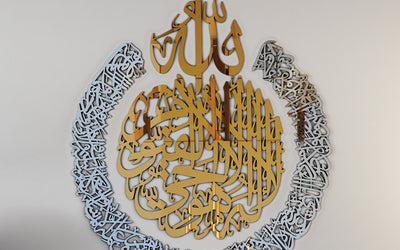
| Shiny gold / silver / copper | Mirrors the room. Picks up lamplight and looks different at every hour. | Rooms with indirect or evening light. Loses definition in strong direct sun. |
| Matte gold / silver / copper | Holds one colour all day. Reads as texture rather than shine. | South-facing rooms and anywhere with a bright window opposite the wall. |
| Black | Reads as a drawn line. The strongest contrast against a pale wall. | White or light-grey walls, and minimalist schemes where metallics would compete. |
On a dark or heavily patterned wall the order reverses: black disappears and a shiny finish is the only one that separates from the background.
One panel, one square, or a set
Three formats cover almost every living room:
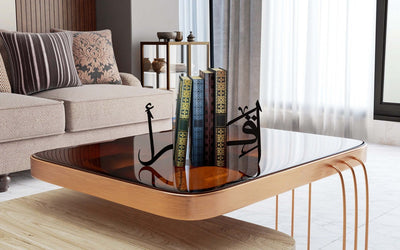
- A single horizontal panel is the simplest answer above a sofa and the hardest to get wrong. One measurement, one fixing line.
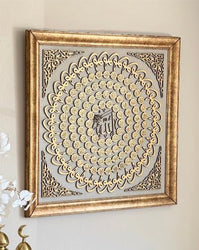
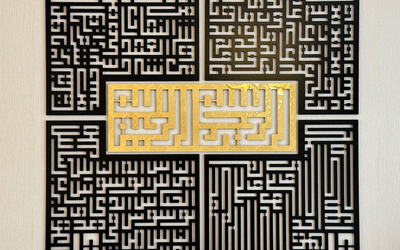
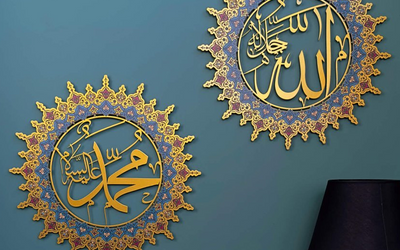
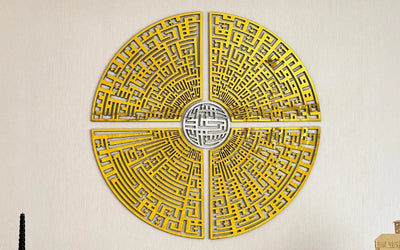
- A square suits a wall between two doors, a chimney breast, or a corner the sofa does not reach. The 99 Names square comes at 47×47, 60×60 and 90×90 cm; the 60 cm reads as a picture, the 90 cm as a feature wall.
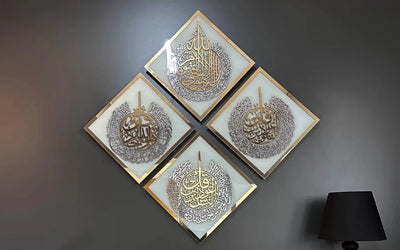
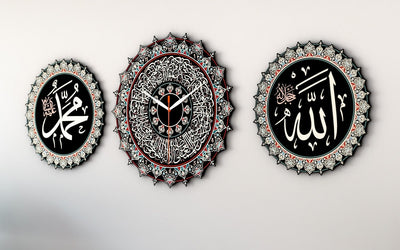
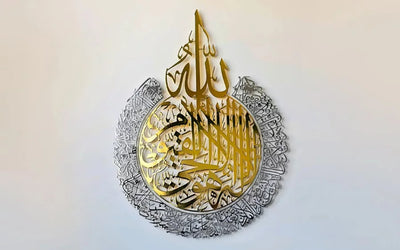
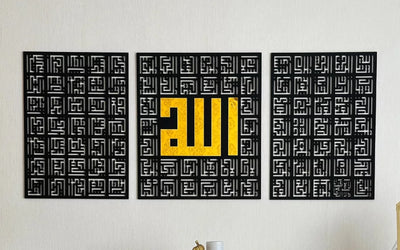
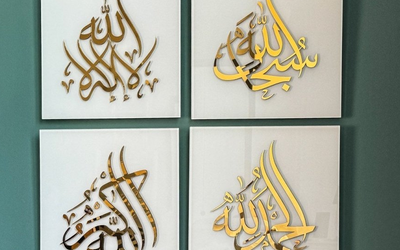
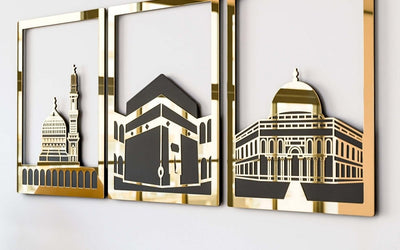
- A multi-piece set spreads across a wide wall without needing one enormous panel. Ayatul Kursi in four pieces covers 94×38 or 140×55 cm. The trade-off is alignment: four fixing lines have to agree, so mark them from a single laser or spirit level rather than measuring each one from the ceiling.
Hanging: the part nobody photographs
Laser-cut metal panels are lighter than they look — most wall pieces at these sizes weigh under 3 kg — but the load is spread across two or more small points rather than one hook.
- Plasterboard: a self-drilling anchor at each fixing point is enough for panels of this weight. Do not rely on adhesive strips for anything over 60 cm wide; the leverage at the ends is what pulls them off, not the mass.
- Brick or concrete: a 6 mm plug and screw, drilled with a hammer setting.
- Multi-piece sets: mark the horizontal line first, then the spacing, then drill. Marking each piece independently is how sets end up stepped.
Check the fixing points on the product page before you buy: pieces with keyhole slots are far more forgiving to level than pieces with a single central hook.
What our own customers actually choose
Guides usually stop at "pick what you love". Our order data over the past twelve months says something more specific, and it contradicts the way most people shop:
- The middle size wins. On almost every piece that ships in three sizes, the middle option outsells both the smallest and the largest. The 99 Names square sells more at 60×60 cm than at 90×90; the Thuluth Bismillah sells more at 130×30 cm than at either 69×15 or 179×40.
- The smallest size is the one people regret. It is consistently the weakest seller in every ladder, and the two-thirds rule above explains why — a 69 cm panel over a 210 cm sofa is roughly a third of the width it needs to be.
- Gold is the default. Across the best-selling metal pieces, gold outsells silver and copper by a wide margin. The exception is horizontal Thuluth calligraphy, where black is the leading finish — the script is doing the work, and black keeps it legible.
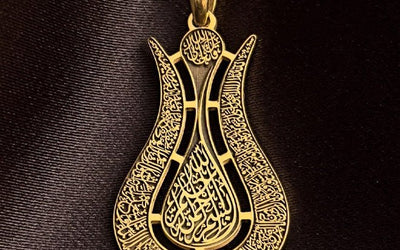
- Where the shape is the point, scale is worth paying for. The tulip-shaped Ayatul Kursi sells better at 57×90 cm than at 43×67.
The practical takeaway: measure the sofa, aim at two thirds, and if you are between two sizes, go up rather than down.
Pieces that suit a living room wall
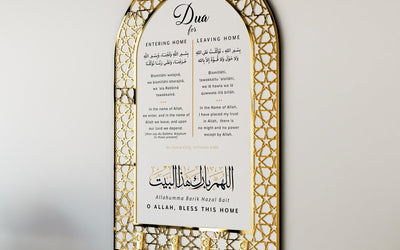
- Dua for Protection — 69×17 or 99×24 cm, seven finishes. Narrow enough for the wall above a console or doorway.
- Ya Allah Bless Our Home — 69×16 or 99×23 cm, a common choice for the entry side of a living room.
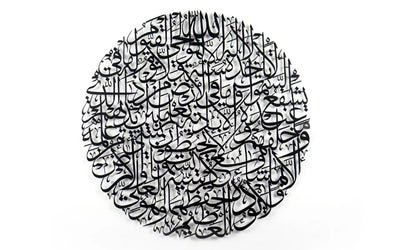
- Ayatul Kursi in matte metal — the widest size ladder we make, from 37×47.5 up to 90×115 cm.
The full metal Islamic wall art collection lists exact dimensions and finish options on every product page, and horizontal pieces are grouped separately if the sofa wall is what you are solving.


Hinterlassen Sie einen Kommentar