


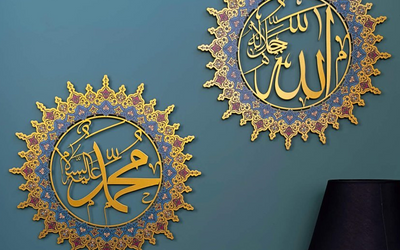
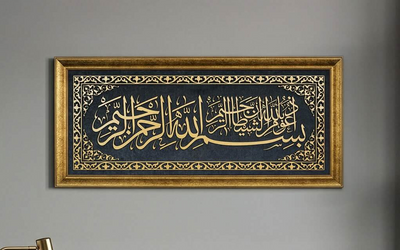
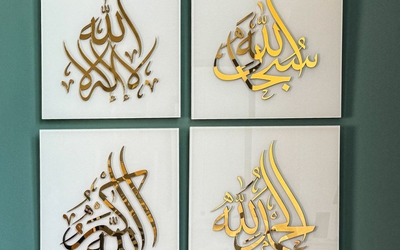
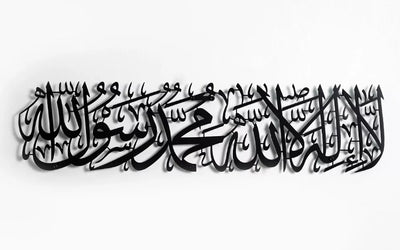

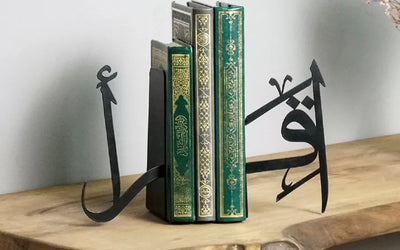
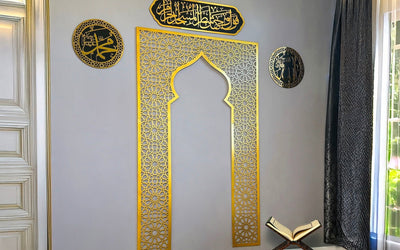
Metal Islamic Wall Decor for the Living Room
Size metal Islamic wall decor for a living room at about two thirds of the sofa's width, then match the finish to your light and check the hanging.


On this page
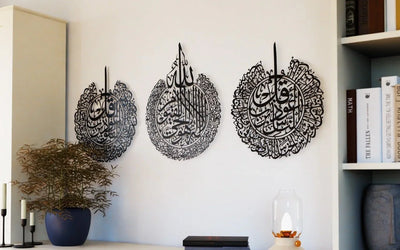
Size metal Islamic wall decor for the living room against the sofa, not the wall: aim for about two thirds of its width, which is 135–145 cm over a three-seater. Then choose the finish for your light and check how the piece hangs. Metal is the most forgiving material for the job: it is light for its size, it holds a hard edge at any scale, and a laser-cut panel casts a shadow line that changes through the day.

Measure the sofa first and aim for two thirds of its width
The wall is bigger than the piece will ever be, so it is the wrong thing to measure against. Measure the sofa.
The working rule in interior design is that art above a sofa should span roughly two thirds of its width. A three-seater is usually 200–220 cm, which puts the target at about 135–145 cm. A two-seater at 150–170 cm puts it at about 100–115 cm. Anything much narrower reads as an afterthought floating in the middle of the wall; anything wider than the sofa itself makes the seating look undersized.
Two more numbers matter and are easy to get wrong:
- 15–25 cm between the top of the sofa back and the bottom edge of the piece. Closer than that and it looks stuck to the furniture; further and the two stop reading as one group.
- 145–150 cm to the center of the piece on a wall with no furniture under it — standing eye level. This is the gallery convention and it is the reason a piece hung "in the middle of the wall" so often feels too high.
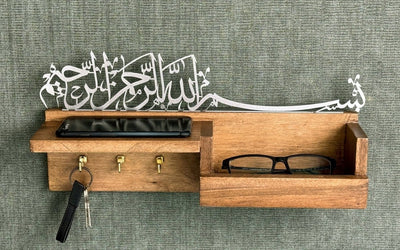
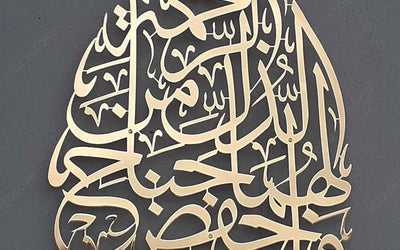
Horizontal calligraphy suits this geometry better than anything else, which is why the format exists. A Thuluth Bismillah panel runs 69×15, 130×30 or 179×40 cm — the middle size sits almost exactly on the two-thirds mark for a two-seater, the largest for a wide three-seater.
Choose the finish against your light, not your taste
Finish is where most of the regret happens, because the sample in a photograph is lit by a studio and your wall is not.
| Finish | Behaves like | Best in |
|---|---|---|
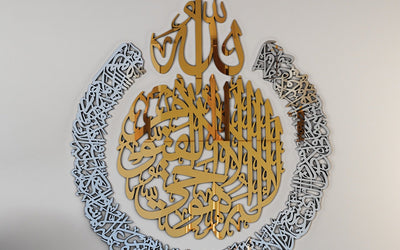
| Shiny gold / silver / copper | Mirrors the room. Picks up lamplight and looks different at every hour. | Rooms with indirect or evening light. Loses definition in strong direct sun. |
| Matte gold / silver / copper | Holds one color all day. Reads as texture rather than shine. | South-facing rooms and anywhere with a bright window opposite the wall. |
| Black | Reads as a drawn line. The strongest contrast against a pale wall. | White or light-gray walls, and minimalist schemes where metallics would compete. |
On a dark or heavily patterned wall the order reverses: black disappears and a shiny finish is the only one that separates from the background.
Pick one panel, one square or a set
Three formats cover almost every living room:
- A single horizontal panel is the simplest answer above a sofa and the hardest to get wrong. One measurement, one fixing line. See our horizontal Islamic wall art.
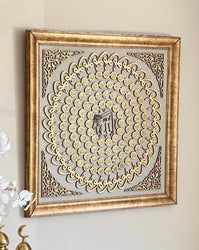
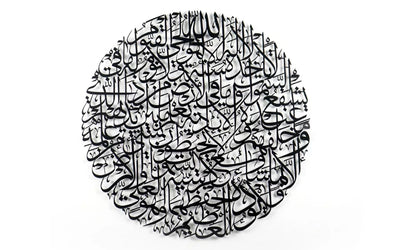
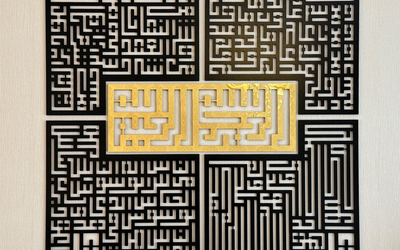
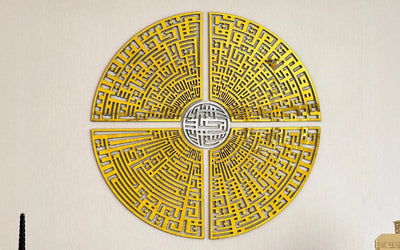
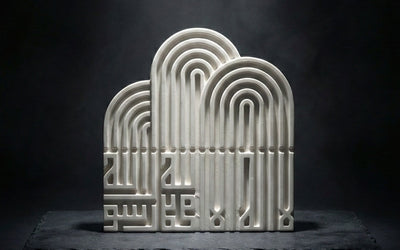
- A square suits a wall between two doors, a chimney breast, or a corner the sofa does not reach. The 99 Names square comes at 47×47, 60×60 and 90×90 cm; the 60 cm reads as a picture, the 90 cm as a feature wall.
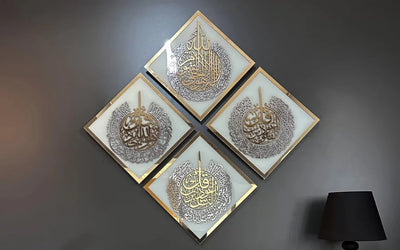
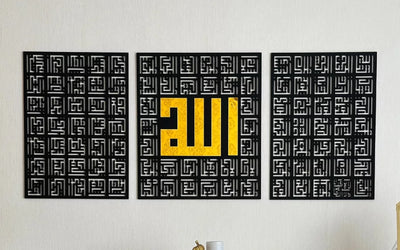
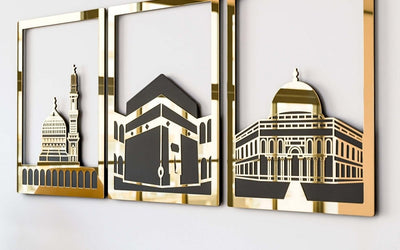
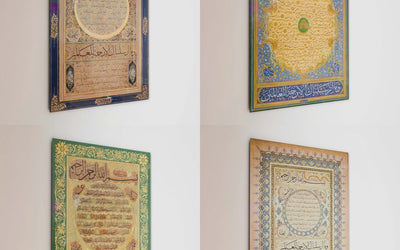
- A multi-piece set spreads across a wide wall without needing one enormous panel. Ayatul Kursi in four pieces covers 94×38 or 140×55 cm. The trade-off is alignment: four fixing lines have to agree, so mark them from a single laser or spirit level rather than measuring each one from the ceiling.
Check what the box contains before you plan the fixings
Metal panels are light for their size, but weights vary a lot with the piece, and the load is spread across two or more small points rather than one hook. These weights come from our product pages:
For multi-piece sets, mark the horizontal line first, then the spacing, then drill; marking each piece independently is how sets end up stepped. For heavier panels on drywall, our guide to hanging metal wall art on drywall matches the hardware to the weight.
What our own customers choose: the middle size, and gold or black
Guides usually stop at “pick what you love”. Our order data for the twelve months to 3 November 2026 says something more specific:
- The middle size wins. On the 99 Names square, 60×60 cm sold 104 units against 67 at 90×90 and 44 at 47×47. On the Thuluth Bismillah, 130×30 cm sold 110 against 89 at 69×15 and 48 at 179×40.
- A narrow piece can fall short of the two-thirds rule. A 69 cm panel over a 210 cm sofa spans about a third of its width, half of the 140 cm the rule suggests.
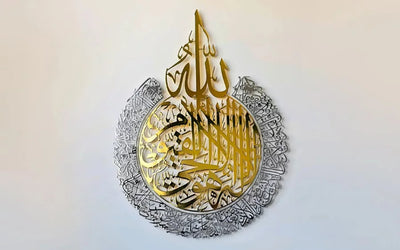
- Finish depends on the piece. Gold leads on the 99 Names square (200 of 215 units) and the tulip Ayatul Kursi, while black leads on the horizontal Thuluth Bismillah (195 of 247) and the four-piece Ayatul Kursi (77 of 150).
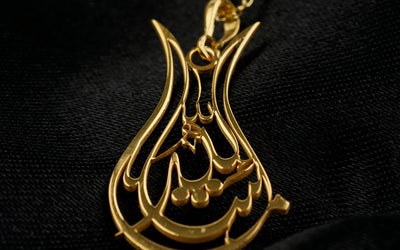
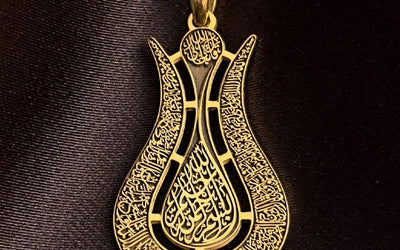
- Where the shape is the point, scale is worth paying for. The tulip-shaped Ayatul Kursi sold 120 units at 57×90 cm against 88 at 43×67.
The practical takeaway: measure the sofa and aim at two thirds. If you are between two sizes, look at the middle one first.
Start with three pieces that suit a living room wall
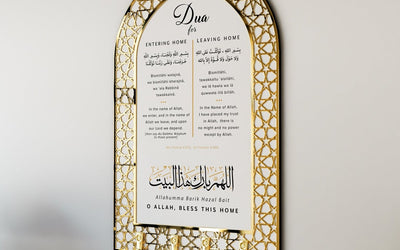
- Horizontal metal dua panel: 69×17 or 99×24 cm, seven finishes. Narrow enough for the wall above a console or doorway.
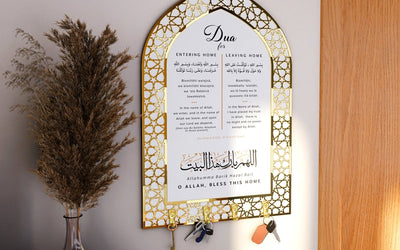
- Horizontal metal dua for the home: 69×16 or 99×23 cm, a common choice for the entry side of a living room.
- Ayatul Kursi in matte metal: the widest size ladder we make, from 37×47.5 up to 90×115 cm.
Frequently asked questions
How wide should wall art above a sofa be?
About two thirds of the sofa's width: roughly 135–145 cm over a three-seater and 100–115 cm over a two-seater, with 15–25 cm between the sofa back and the bottom edge.
Which finish is best for a living room?
Shiny finishes suit rooms with indirect or evening light, matte suits bright south-facing rooms, and black gives the strongest contrast on a pale wall.
How heavy is a metal Islamic wall piece?
From 0.8 kg for the 69×15 cm Thuluth Bismillah to 7.2 kg for the 90×115 cm matte Ayatul Kursi, according to the product pages.
When you are ready to choose, browse our metal Islamic wall art, where each product page lists its sizes, weights and finishes.
Sizes, weights and hanging notes come from our product pages; order figures are from our own store data for the twelve months to 3 November 2026. Photographs are of our own products. This article was prepared with AI assistance. Updated November 2026: added a weight table checked against product pages, exact order figures, a direct answer and a FAQ, and replaced unsourced hanging advice with what the product pages list.
Find the piece for your wall
Browse the collection behind this guide. You have 30 days after receiving your order to request a return.


Leave a comment