









Islamic Metal Wall Clock Models for Your Home
Choosing an Islamic metal wall clock: finishes, movement noise, sizing for the wall you have, and which designs suit which rooms.

في هذه الصفحة
A wall clock is the one piece of Islamic wall art that has to work twice: as calligraphy on the wall, and as something you can read from the other side of the room. Those two jobs pull in opposite directions, and that is what makes choosing one different from choosing a panel.

Size is a legibility question, not a decorating one
With a wall panel you size against the furniture. With a clock you size against the viewing distance, because a dial you cannot read is an ornament that happens to have hands on it.
Our clocks come in three diameters, and each has a clear job:
| Diameter | Readable from | Where it belongs |
|---|---|---|
| 33 cm | about 3 m | Hallways, kitchens, a study wall you sit close to |
| 47–48 cm | about 5 m | Living rooms and open-plan spaces. This is the standard size across our range for a reason. |
| 67 cm | 8 m and beyond | Double-height walls, long rooms, a clock meant to be the focal point |
One caution specific to calligraphic dials: the script and the hands occupy the same surface. On a dense design, going small costs you more legibility than the diameter alone suggests, because the hands have to compete with the letterforms behind them. If the design is intricate and the room is a living room, 47–48 cm is the sensible floor rather than the middle option.
Arabic or Latin numerals
Most of our clocks offer both, and the choice is more practical than it looks. Eastern Arabic numerals (١ ٢ ٣) are the right answer where everyone in the house reads them fluently and the clock is partly a decorative statement. Latin numerals are the right answer in a mixed household, a guest room, or a shared space where children are learning to tell the time — a dial nobody reads at a glance gets ignored.
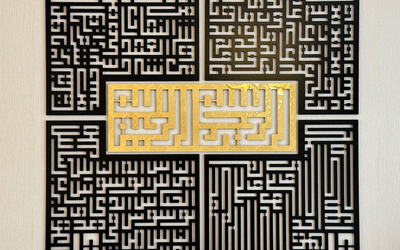
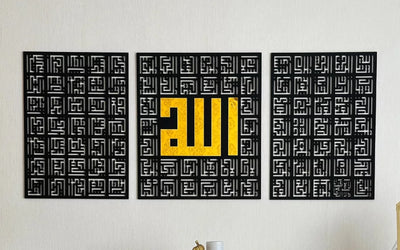
A middle path exists: several designs, such as the First Kalima Kufic clock, put the calligraphy in the body of the piece and keep the dial itself plain. You get the script without paying for it in readability.
Movement noise
This is the detail buyers most often overlook and most often regret. A standard quartz movement ticks once a second, and in a quiet room — a bedroom, a prayer corner, a study — that tick is audible and, for some people, impossible to ignore. A continuous-sweep ("silent") movement has no audible step.
Neither is better in the abstract; it depends on the room. But check which one a clock uses on the product page before you hang it anywhere you expect quiet. It is not a fault you can fix after the fact without replacing the movement.
Where a clock actually works
- On a wall you face. Above the sofa is the standard place for a panel and the wrong place for a clock — you sit with your back to it. Put the clock on the wall opposite the seating.
- At or just above eye level. Around 150–165 cm to the centre. Higher than that and you read it at an angle, which is exactly when a dense dial becomes hard work.
- Away from direct sun. Not for the movement's sake but for the finish: shiny metal in a sun patch loses all its definition for several hours a day.
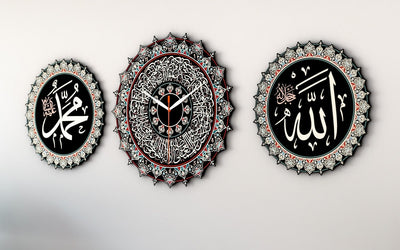
- Not as one of a pair with a panel on the same wall. Two circular objects at the same height compete. If you want both, stagger the heights or separate them.
Models worth looking at
- Surah Al-Ikhlas metal clock — the fullest range we carry: all three diameters, Arabic or Latin numerals, four finishes.
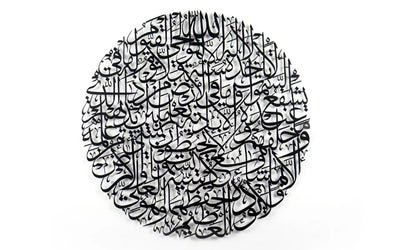
- Ayatul Kursi metal clock — 48 or 67 cm, for a wall where the clock is meant to be the main piece.
- Allah (SWT) clock with Latin numerals — 35×48 or 47×65 cm, a vertical shape rather than a circle, which solves a narrow wall.
- Surah Al-Ikhlas in shiny metal — one size, 47.5 cm, in gold, silver or copper.
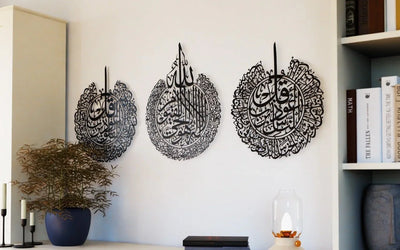
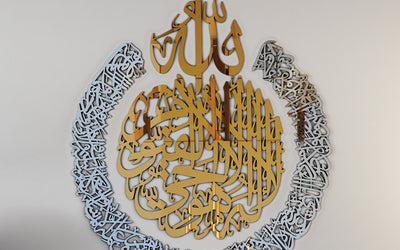
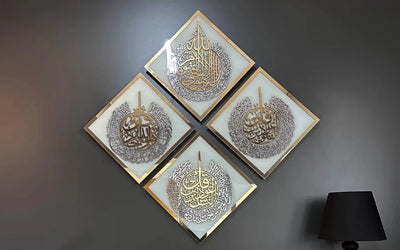
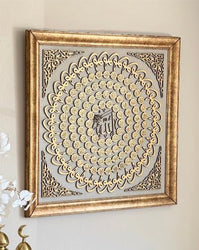
The full Islamic wall clock collection lists diameter, numeral style and finish on every product page. If a clock turns out to be the wrong object for the wall, the metal wall art collection covers the same calligraphy without the dial.


ترك تعليق