



The Most Beautiful Islamic Wall Art Models
A tour of the main Islamic wall art styles, what distinguishes each, and how calligraphy history shapes the designs sold today.

Sur cette page
Islamic wall art looks like one category until you start shopping, at which point it turns out to be eight or nine quite different things. Sorting them by what the piece says — rather than by material or price — makes the choice much easier, because the text is what decides where a piece belongs and who it suits.

The eight families
1. Verse panels
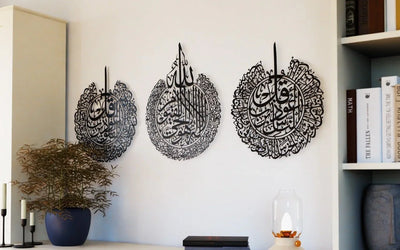
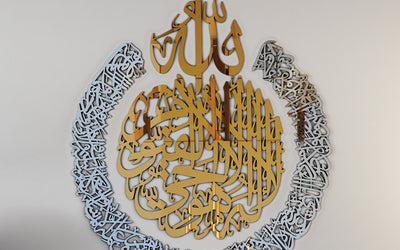
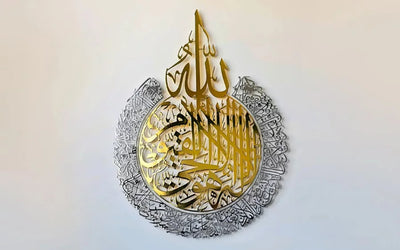
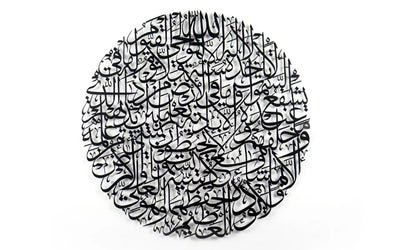
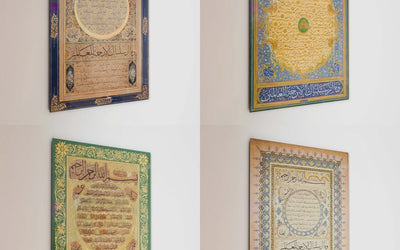
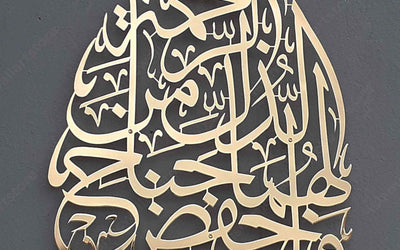
A single Qur'anic verse rendered as one composition. Ayatul Kursi is by far the most common, followed by Surah Ar-Rahman verse 13 and the opening of Al-Fatiha. These are the largest pieces in most catalogues because the text is long, and they are the ones that want a wall to themselves.
Suits: a living room feature wall, an entrance hall, a wall with no furniture beneath it.
2. Name pieces
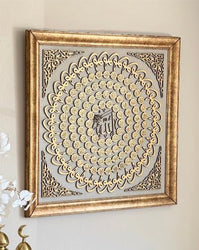
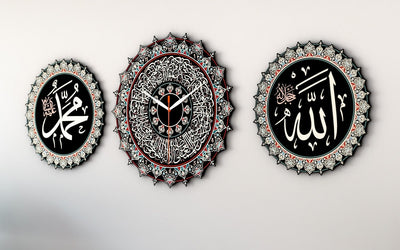
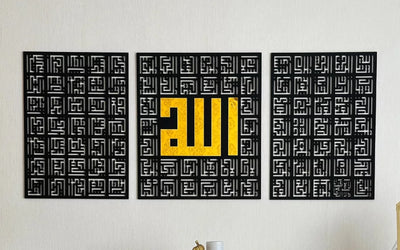
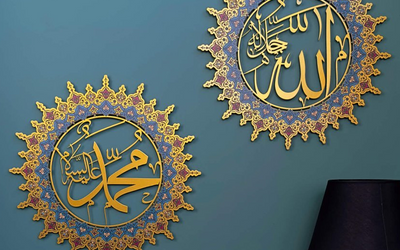
Allah and Muhammad as a matched pair, or the ninety-nine names — Asma ul Husna — gathered into a single square or spread across many small pieces. The paired format is symmetrical by nature, which makes it the easiest family to hang: two identical pieces, one spacing decision.
Suits: either side of a doorway, above a bed, flanking a mirror or a fireplace.
3. The declaration
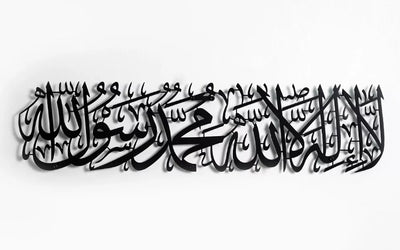
The First Kalimah and the Shahadah are short, which is why they work as long narrow horizontals — typically 65–100 cm wide and only 16–24 cm tall. That proportion fits places nothing else does.
Suits: above a door frame, along a hallway, above a headboard, over a low sideboard.
4. Dhikr sets
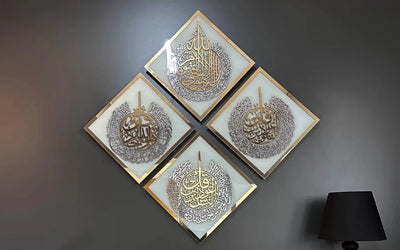
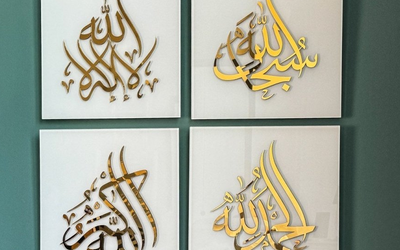
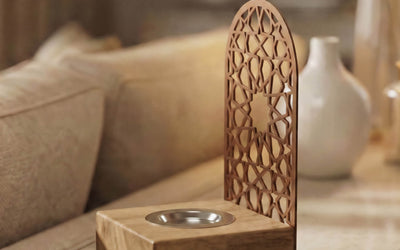
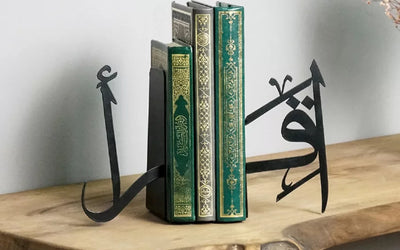
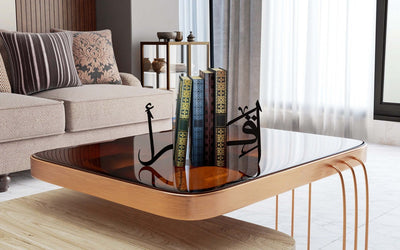
SubhanAllah, Alhamdulillah and AllahuAkbar as three separate pieces. Dhikr sets exist as wall panels and as tabletop pieces, and the tabletop version is one of our best-selling categories — they need no drilling and move between shelf, mantel and desk.
Suits: a shelf, a rented home, a wall too narrow for a single large piece.
5. Dua pieces
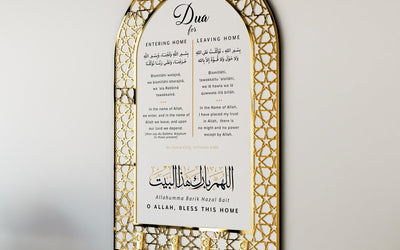
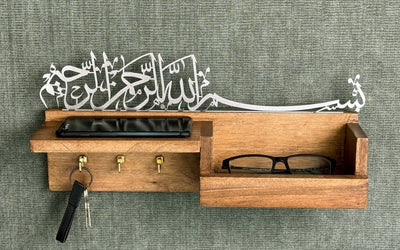
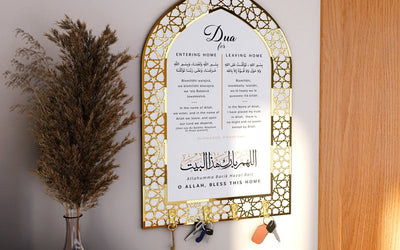
Supplications tied to a specific place or moment: dua for protection, dua for barakah, the dua for entering and leaving the home. This family is the most function-led, and it shows in what people buy — the entering-and-leaving dua, made as a key holder for the hallway, is the single best-selling item in our catalogue.
Suits: the specific room the dua belongs to. That is the whole point of the family.
6. Mosques and sacred places
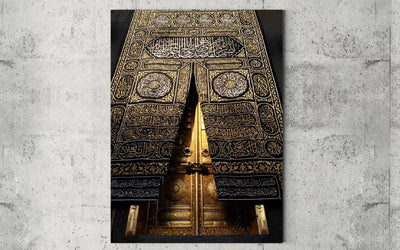
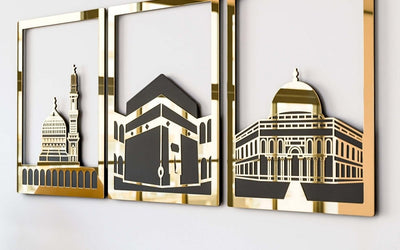
The Kaaba, Masjid an-Nabawi and Masjid al-Aqsa, usually as a set of three. Pictorial rather than calligraphic, which makes them the family that behaves most like conventional art — and the one where canvas and print compete seriously with metal.
Suits: a wide wall, a stair wall, a room where a run of three works better than one large piece.
7. Mihrab and prayer-corner pieces
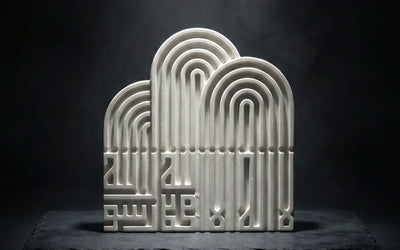
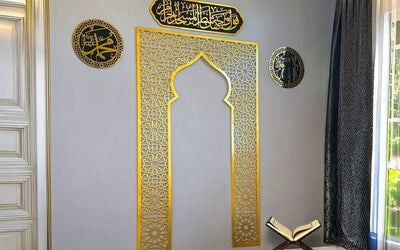
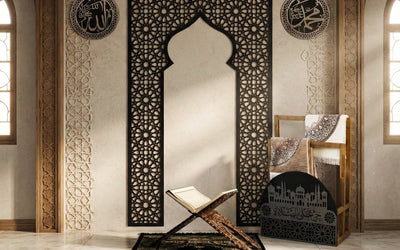
Arched panels that echo the prayer niche. Mihrab designs are the one family with a fixed orientation — they mark the qibla wall, so they are chosen for a spot rather than a look.
Suits: a prayer corner or prayer room. Our guide to setting up a prayer corner covers the measurements.
8. Short phrases
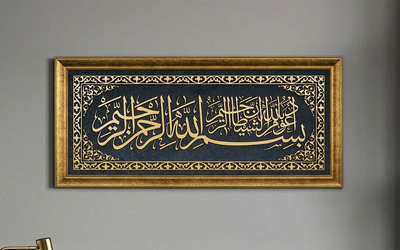
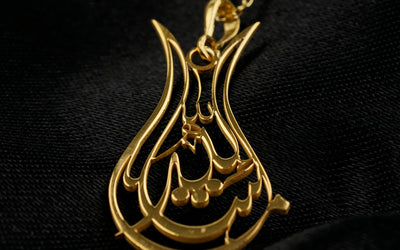
Bismillah, MashAllah, Alhamdulillah, Hasbunallah. Short enough to be legible at any size, which makes this the most flexible family — and the most common gift, because it needs no explanation and fits any home.
Suits: almost anywhere. Kitchens, entryways, children's rooms, gifts.
A correction worth making
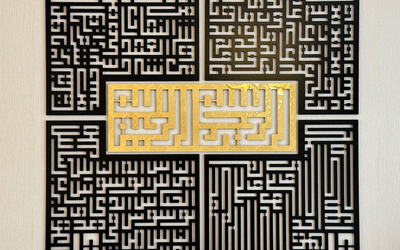
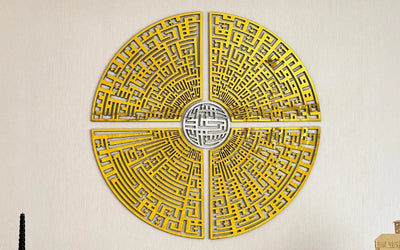
You will frequently read that Islamic calligraphy comes in "two basic forms, Kufic and Khatt". That is not right. Khatt (خط) is the Arabic word for script or handwriting — it is the general term for calligraphy, not a style. Kufic is a khatt.
The real division is between the angular family, of which Kufic is the ancestor, and the cursive family codified in the tenth century as the six pens: Thuluth, Naskh, Muhaqqaq, Rayhani, Tawqi' and Riqa'. Our guide to the scripts explains how to tell them apart on a finished piece.
Choosing between families
| If you have | Look at |
|---|---|
| One large empty wall | A verse panel, or a mosque set of three |
| A narrow strip above a door or bed | The declaration, or a short phrase |
| Two symmetrical spaces | A name pair |
| A shelf and no permission to drill | A dhikr or tabletop set |
| A specific room in mind | A dua piece made for it |
| A prayer corner | A mihrab panel |
Browse everything in the full collection, or narrow by material: metal, wood and acrylic, tempered glass or canvas.


Laissez un commentaire