











How Far Apart Should You Hang a 3- or 5-Piece Wall Art Set?
Leave 5–10 cm (2–4″) between pieces and center the group about 145 cm (57″) up. Spans and layouts for real 3-, 4- and 5-piece sets, gaps included.

Sur cette page
Leave 5–10 cm (2–4″) between the pieces of a set, line them up on one shared centerline, and put the middle of the whole group, not of each piece, about 145 cm (57″) from the floor, or 15–25 cm (6–10″) above the furniture below it. Before any of that, add the gaps to the piece widths: three 37 cm panels with 8 cm gaps become a 127 cm arrangement.
That last step is easy to skip. A set is often described piece by piece on a product page but seen as one object on the wall, so the number that matters is the width of the finished arrangement. Below are the spans of real sets from our catalog with the gaps included, the layouts that suit three, four and five pieces, and a paper-template method for getting the holes in the right place the first time.
Work out the finished span before you choose a wall
A set listing gives one of two kinds of measurement, and they are not interchangeable.
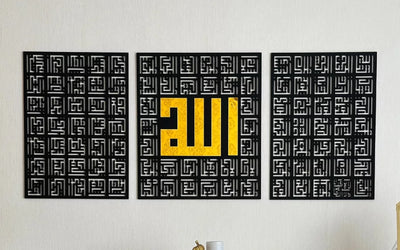
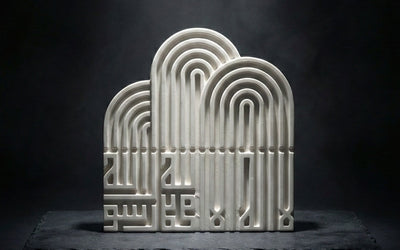
- Per-piece sizes. Most sets list each piece. Our four-piece wooden surah set is 49 × 49 cm for each part; the stonecast Kufic trio is 30 × 30 cm per piece, and its listing tells you to allow for the whole run rather than one piece. The gaps are yours to choose, and the finished size depends on them.
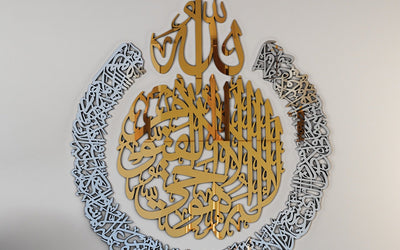
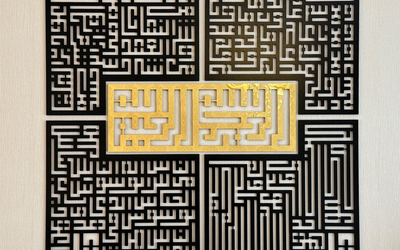
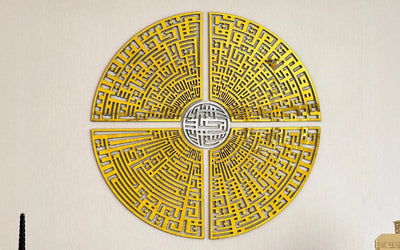
- The size of the finished arrangement. Some designs are sold as one composition. The five-piece Kufic square, four surah panels around a central Bismillah band, is listed at 70, 90, 120 or 150 cm, and the size chart on the listing draws that square around all five pieces. The spacing is part of the design: you hang it as drawn.
For a per-piece set the arithmetic is short: add the piece widths, then add one gap fewer than there are pieces. Hold the result against the furniture or wall it will sit above. Our size guide explains why the target is 60–75% of the furniture width; the last column below applies that rule. The gap column is our choice within the usual range, not a figure from the listings.
| Set and layout | Pieces as listed | Gap | Finished arrangement | Furniture width it suits |
|---|---|---|---|---|
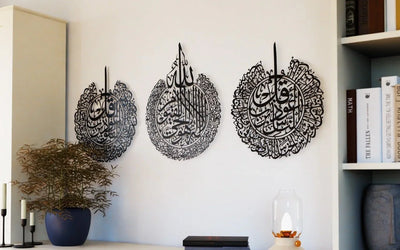
| Stonecast Kufic trio, in a row | 3 × 30 × 30 cm | 5 cm | 100 × 30 cm · 39 × 12″ | 135–165 cm · 53–65″ |
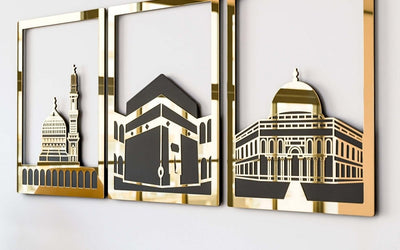
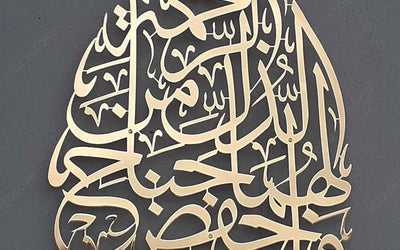
| Metal Ayatul Kursi, Falaq and Nas, medium, in a row | 37 cm wide each; Ayatul Kursi 47.5 cm tall, the other two 42.5 cm | 8 cm | 127 × 47.5 cm · 50 × 19″ | 170–210 cm · 67–83″ |
| Same set, large, in a row | 49 + 50 + 50 cm wide; Ayatul Kursi 63 cm tall, the other two 57 cm | 10 cm | 169 × 63 cm · 67 × 25″ | 225–280 cm · 89–110″ |
| Wooden four-piece set, 2 × 2 grid | 4 × 49 × 49 cm | 5 cm | 103 × 103 cm · 41 × 41″ | 135–170 cm · 53–67″ |
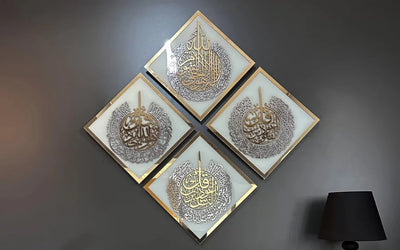
| Same set, grid turned 45° | 4 × 49 × 49 cm | 5 cm | about 146 × 146 cm · 57 × 57″ | 195–245 cm · 77–96″ |
| Wooden five-piece set, small, in a row | 5 × 30 × 40 cm | 5 cm | 170 × 40 cm · 67 × 16″ | 225–285 cm · 89–112″ |
| Same set, medium, one piece flanked by two pairs | 5 × 40 × 53 cm | 8 cm | 136 × 114 cm · 54 × 45″ | 180–225 cm · 71–89″ |
| Five-piece Kufic square, 120 cm | Sold as one square | Built in | 120 × 120 cm · 47 × 47″ | 160–200 cm · 63–79″ |
Two rows deserve a second look. The same four squares need 103 cm of wall as a grid and about 146 cm turned on point, because a square standing on its corner is roughly 1.4 times as wide as its side. And the large three-piece set needs more wall than most sofas give it: at 169 cm it wants furniture of about 225 cm or more, or a clear wall with nothing beneath it.
Choose a layout that matches the shape of the wall
Three pieces: a row on one centerline
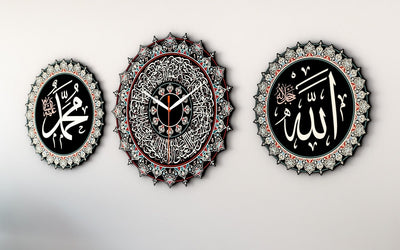
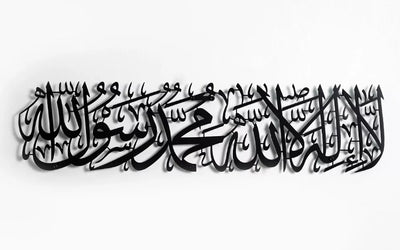
Three pieces almost always go in a row. The real question is how to line them up when they are not the same height. In the medium size of this three-piece metal set, the Ayatul Kursi piece is 47.5 cm tall and the two surah pieces are 42.5 cm. Hang the taller one in the middle, align all three on their centers, and it rises 2.5 cm above its neighbors and drops 2.5 cm below them, a symmetrical outline that reads as intended. Align the tops instead and the whole 5 cm difference collects along the bottom edge, the edge nearest the sofa.
A vertical stack is the exception, for a narrow wall between two doors or beside a window. Three 30 cm squares with 5 cm gaps make a column 100 cm tall and only 30 cm wide.
Four pieces: a grid, a row, or on point
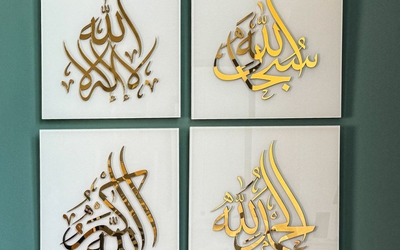
Four equal squares give you three options. A 2 × 2 grid is the most compact and suits a console or sideboard wall with height to spare. A single row of four 49 cm squares runs to 211 cm with 5 cm gaps, which only a long wall can carry. Turned 45°, the grid becomes a diamond, the arrangement in the photograph below, and grows by about 40% in both directions. In a grid or a diamond, keep the gaps at the tight end of the range: each piece meets its neighbors on two sides, and wide gaps break the block apart.

Shown: the four-piece wooden set, 49 cm square per piece, in black.
Five pieces: a long row, or one piece with two pairs
Five is where layout matters most, because a row of five gets long quickly. Our five-piece Ayatul Kursi and four Quls set in wood is listed per piece in three sizes: 30 × 40, 40 × 53 and 50 × 66 cm. In the small size, five in a row with 5 cm gaps already span 170 cm. In the medium size, with 8 cm gaps, the row reaches 232 cm, wider than most sofas. Hang one piece alone in the middle and stack the other four as two pairs on either side, and the same medium set fits into 136 × 114 cm.
The five-piece Kufic square takes the decision away. Its five pieces fit together into one square, so you choose the size, not the layout.
Look at what buyers of multi-piece sets chose
In the twelve months to early November 2026, the four-piece Ayatul Kursi arrangement in metal sold 150 units, tenth among all the products currently in our catalog. It is listed in two sizes, 94 × 38 cm and 140 × 55 cm, and its single most-ordered option was the larger size in black, at 62 units. In the same period the five-piece Kufic square sold 115 units and the wooden four-piece set 54.
For a set, size is harder to correct after the fact than for a single piece. If your finished span comes out short of the 60% mark, widening the gaps is not the fix: beyond about 15 cm the pieces stop reading as one group and start reading as three or five separate decisions. Step up a size instead, or pick a layout that spreads sideways, like a row instead of a grid.
Rehearse on paper, then drill
Holes are the only part of this you cannot undo, so rehearse first.
- Trace each piece onto kraft paper or the back of wrapping paper, cut it out and note on it which piece it stands for.
- Mark the hanging point on each template. Lay the piece face down, measure from its top edge and one side to the hook or bracket, and transfer that point to the paper.
- Cut a spacer: a strip of card exactly as wide as your chosen gap. Use it between every pair of templates so the gaps stay identical.
- Tape the templates up with low-tack masking tape. Find the center of the whole group and set it at 145 cm (57″), or set the lowest edge 15–25 cm above the furniture. Check the shared centerline with a level.
- Leave it for a day. Look at it from the seat you use most and from the doorway, not from arm’s length.
- Drill through the paper at the marked points, peel the templates away, and hang the middle piece first, working outward.

The fixings depend on the weight and on what the wall is made of. Weights are on the listings: the five-piece Kufic square is listed at 3.6 kg in the 90 cm size and 6.8 kg at 120 cm, and each piece of the stonecast trio at 1.7 kg, with brackets already fitted and a note to lift it with two hands rather than slide it. Our guide to hanging metal wall art on drywall matches hardware to weight.
Short answers on spacing, height and layout
How far apart should a set of three be hung?
5–10 cm (2–4″) is the usual range: the tight end for small pieces around 30 cm, the wide end for pieces around 50 cm. Keeping every gap identical matters more than the exact number.
Does the listed size include the gaps?
Only when the listing is for a finished arrangement, like the five-piece Kufic square. A per-piece listing gives you the piece; add the gaps yourself.
Should the set be centered on the sofa or on the wall?
On the furniture it sits above. With nothing beneath it, center it on the clear stretch of wall between whatever bounds it, such as a door frame, a corner or a window.
Can the pieces of a set go on different walls?
Per-piece sets can. The stonecast trio’s listing says the pieces can hang as one horizontal row or separately. A composition like the Kufic square is designed to be seen together.
How high should a tall five-piece layout hang?
Apply the 145 cm center to the whole group, then check the bottom edge. Centered at 145 cm, the 114 cm tall arrangement starts 88 cm from the floor; if that leaves less than 15 cm above your sofa back, raise the whole group until it does not.
Every set in this guide, along with the single pieces that group the same way, is in our full Islamic wall art collection.
A note on scope: this guide covers measurement, layout and installation only. Several of the sets shown carry Qur'anic text; questions of religious practice, including where and how such text should be displayed in the home, are matters on which scholars differ, and we would encourage you to consult your own local scholar rather than take guidance from a retailer.
Sales figures are from our own store data for the twelve months to November 3, 2026. Piece sizes and weights come from the product listings; finished spans and furniture widths are our own arithmetic, using the 60–75% rule from our size guide. The 5–10 cm gap and the 145 cm (57″) center height follow widely used picture-hanging practice. Illustrative images marked as such were generated with AI; product photographs are of our own products. This article was prepared with AI assistance.


Laissez un commentaire